
How Much Does Sewer Line Replacement Cost in Kyle TX? (2026)
“They said the line needs replacing.” That’s the sentence that turns a plumbing problem into a five-figure question — and the next question is always the same: is this a $4,000 job or a $25,000 job? The honest answer is that sewer line replacement cost varies more than almost any other home repair, because the…
“They said the line needs replacing.” That’s the sentence that turns a plumbing problem into a five-figure question — and the next question is always the same: is this a $4,000 job or a $25,000 job?
The honest answer is that sewer line replacement cost varies more than almost any other home repair, because the price isn’t really about the pipe — it’s about the length, the depth, the soil, what’s sitting on top of the line, and how it’s replaced. This guide breaks down the borrowed Texas ranges, the six drivers that move your quote, and the restoration costs that catch homeowners by surprise.
One note before the numbers: no Kyle-specific sewer replacement pricing is published anywhere. Every figure below is a borrowed Texas-wide range (Houston guides, Angi Austin/Dallas), labeled as such. Your exact Kyle quote is confirmed on the call, after a camera inspection documents your line — never before.
If you haven’t had a camera inspection yet, start there. A replacement quote without footage is a guess. Call (512) 729-5265 for sewer leak detection in Kyle TX first.
Borrowed Texas Ranges: The Big Picture
| Method | Borrowed Texas total range | Borrowed per-foot range |
|---|---|---|
| Traditional dig-and-replace | $3,800–$14,250 | $50–$190/ft |
| Trenchless pipe bursting | $5,700–$11,400 | $60–$200/ft (bursting work) |
| Trenchless CIPP lining | $3,800–$8,550 | $90–$250/ft |
| Full replacement, all methods (Houston guides) | $3,500–$12,000+ | — |
| Full replacement (Angi Austin) | $4,000–$33,000 | $50–$250/ft conventional |
The ranges are wide because the jobs are genuinely different: replacing a 40-foot shallow lateral in an open side yard is a different project from replacing a 150-foot deep line under a driveway, a patio, and three mature oaks. The table gives you the landscape; the six drivers below explain where in it your job lands.
The 6 Cost Drivers That Move Your Quote
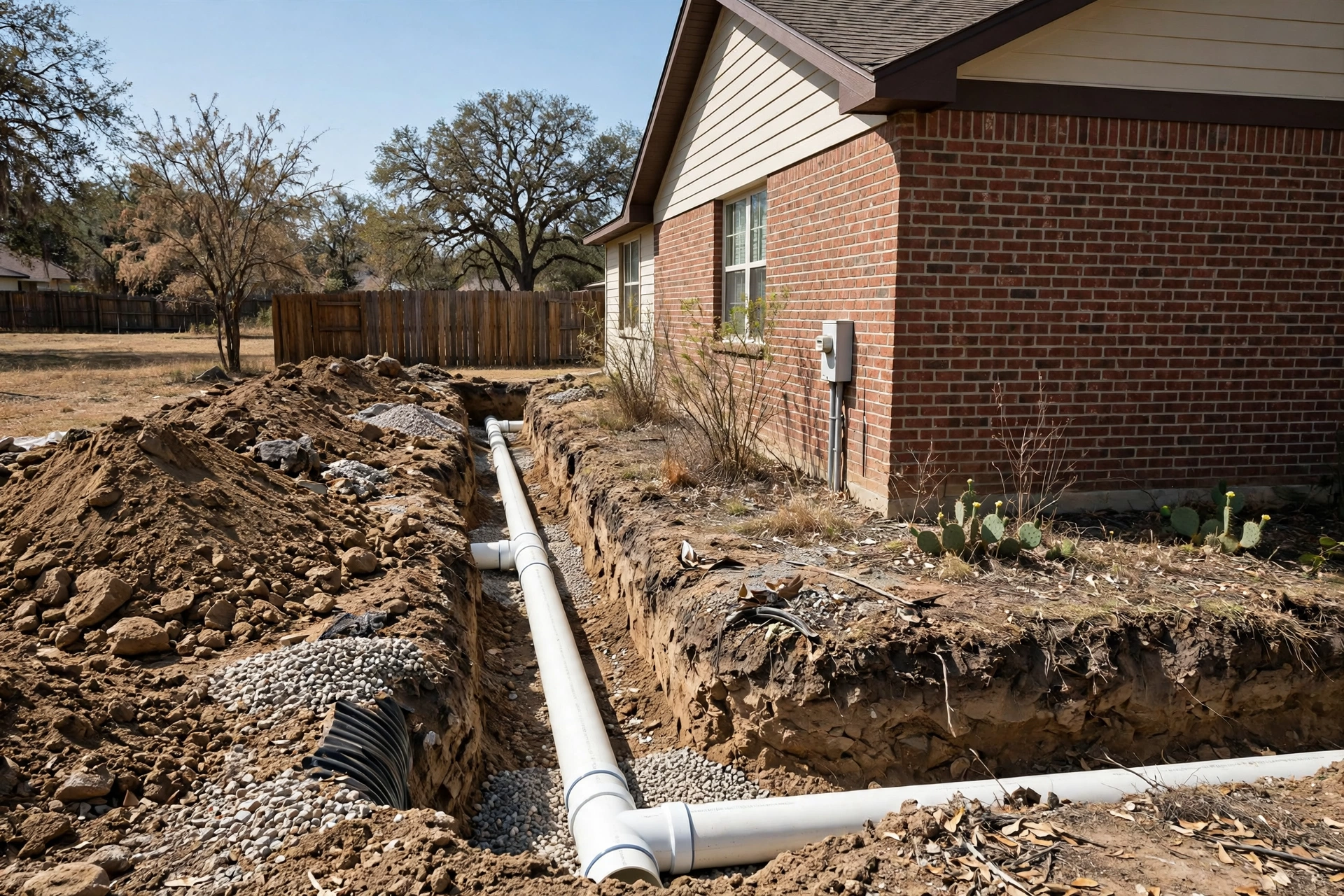
1. Length of the line. This is the single biggest driver. Sewer laterals in Kyle subdivisions run from the house to the street main, and lot depth varies enormously. Every additional foot adds pipe, labor, and (for digging) excavation. A per-foot rate that looks reasonable on a short run becomes a large total on a long one — always ask for the measured length behind the quote.
2. Depth. Shallow lines (3–4 feet) are fast to expose. Deep lines (6–10+ feet) need shoring, more excavation, more backfill, and more crew time. Depth also interacts with method: very deep lines can make trenchless more attractive, since the excavation savings grow with depth.
3. Soil and ground conditions. Central Texas expansive clay soil swells when wet and shrinks when dry — it moves, and it makes excavation slower and less predictable. Rocky soil, high water tables, and unstable trench walls all add time and equipment. A quote that doesn’t account for your soil is a quote that will change on arrival.
4. What’s on top of the line. This is the driver homeowners underestimate most. A line under open lawn is cheap to reach. A line under a concrete driveway, a patio, a sidewalk, a deck, or mature landscaping is not — each surface must be cut, removed, and restored.
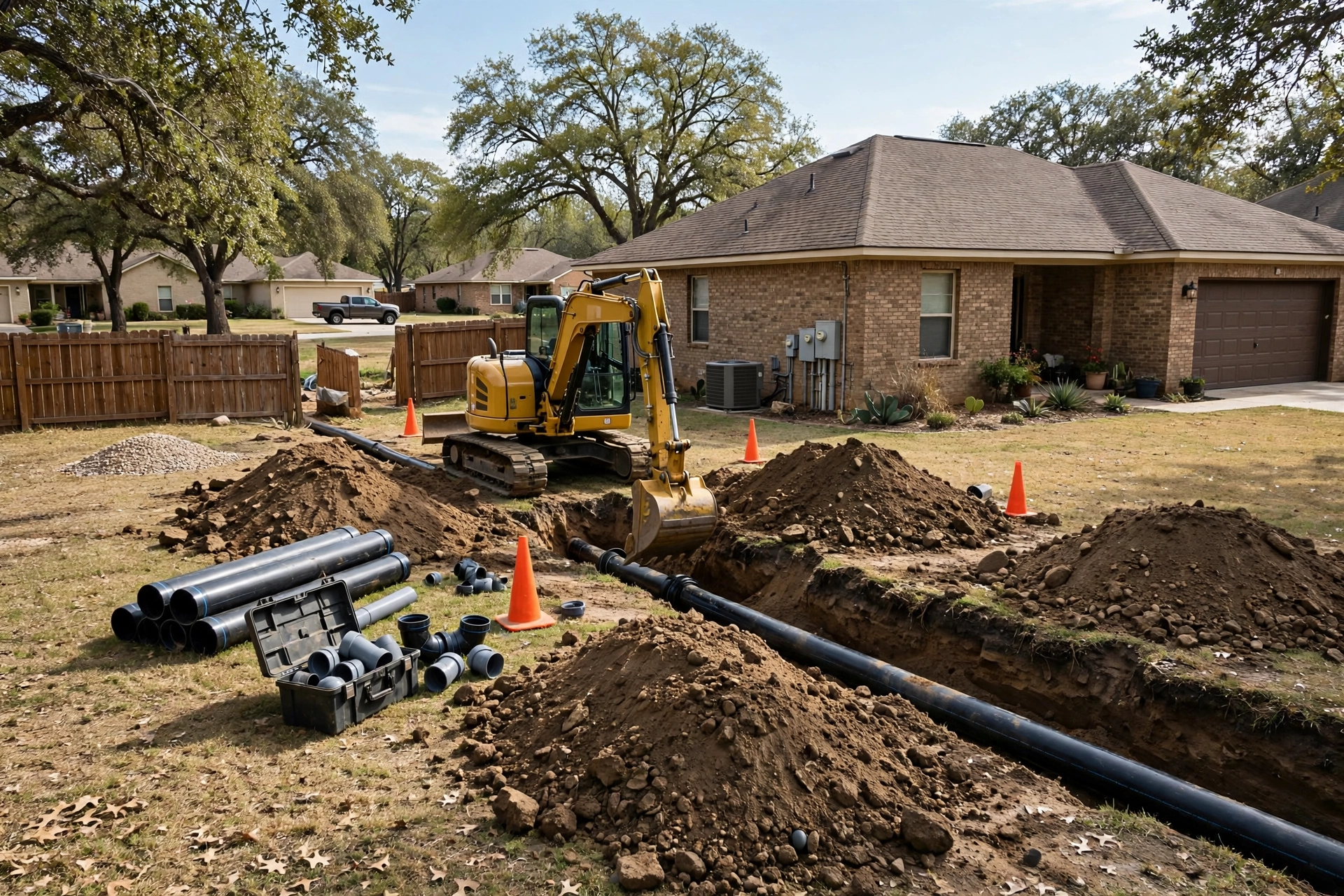
Restoration alone runs a borrowed $950–$4,750 (Houston guides) for landscape, sod, concrete, or asphalt patching after a traditional dig. This is where trenchless earns its premium: it mostly avoids this entire category.
5. Method: traditional vs trenchless. Traditional dig-and-replace usually has the lower pipe-and-labor price but the higher restoration bill. Trenchless (bursting or lining) costs more per foot but arrives with minimal restoration. Compare complete written totals — pipe, labor, permits, and restoration — not headline rates. For the trenchless methods in detail, see the cluster’s trenchless guide.
6. Permits, inspections, and access. Borrowed Houston figures put permits and inspection fees at $200–$475, typically handled by the contractor. Access matters too: a cleanout in the yard makes the job easier; no cleanout, or a line accessible only through a structure, adds labor. Some jobs also need a new cleanout installed ($475–$1,900 borrowed) for future access — worth it, but it belongs in the quote, not as a surprise.
The Restoration Costs People Forget
When comparing quotes, homeowners almost always compare the pipe price and forget the property price. After a traditional dig, someone has to:
- Backfill and re-grade the trench
- Replace sod or re-landscape the disturbed strip
- Patch or replace concrete (driveway, sidewalk, patio sections)
- Repair irrigation lines cut during excavation
- Clean up and haul away spoil
Borrowed Houston restoration ranges ($950–$4,750) cover typical cases; a driveway section or extensive hardscaping can exceed them. If a quote says “restoration not included,” that’s not a lower price — it’s an incomplete one. Ask every bidder the same question: “What does my property look like when you leave, and is that in this number?”
Traditional vs Trenchless: Total-Cost Thinking
A worked comparison shows why totals matter more than rates:
- Traditional dig on a 60-foot line under lawn: lower per-foot pipe cost, but add excavation labor, backfill, re-grading, and sod. Total lands in the borrowed $3,800–$14,250 band, toward the lower-middle for an open-lawn run.
- Trenchless bursting on the same 60-foot line: higher per-foot cost, but the lawn stays, the restoration line nearly disappears, and the job finishes faster. Total lands in the borrowed $5,700–$11,400 band.
- Traditional dig on a 60-foot line under a driveway: the pipe price is similar to the lawn case, but now add concrete cutting, removal, and replacement — and the total can overtake the trenchless number entirely.
The right method isn’t the cheapest headline — it’s the cheapest complete job that actually fixes your documented damage. And “documented” is doing heavy work in that sentence: the camera report decides which methods are even options.
How to Get a Quote You Can Trust
If you are unsure whether replacement is warranted at all, first review the sewer line leak signs in Kyle TX — then follow these steps before accepting any quote.
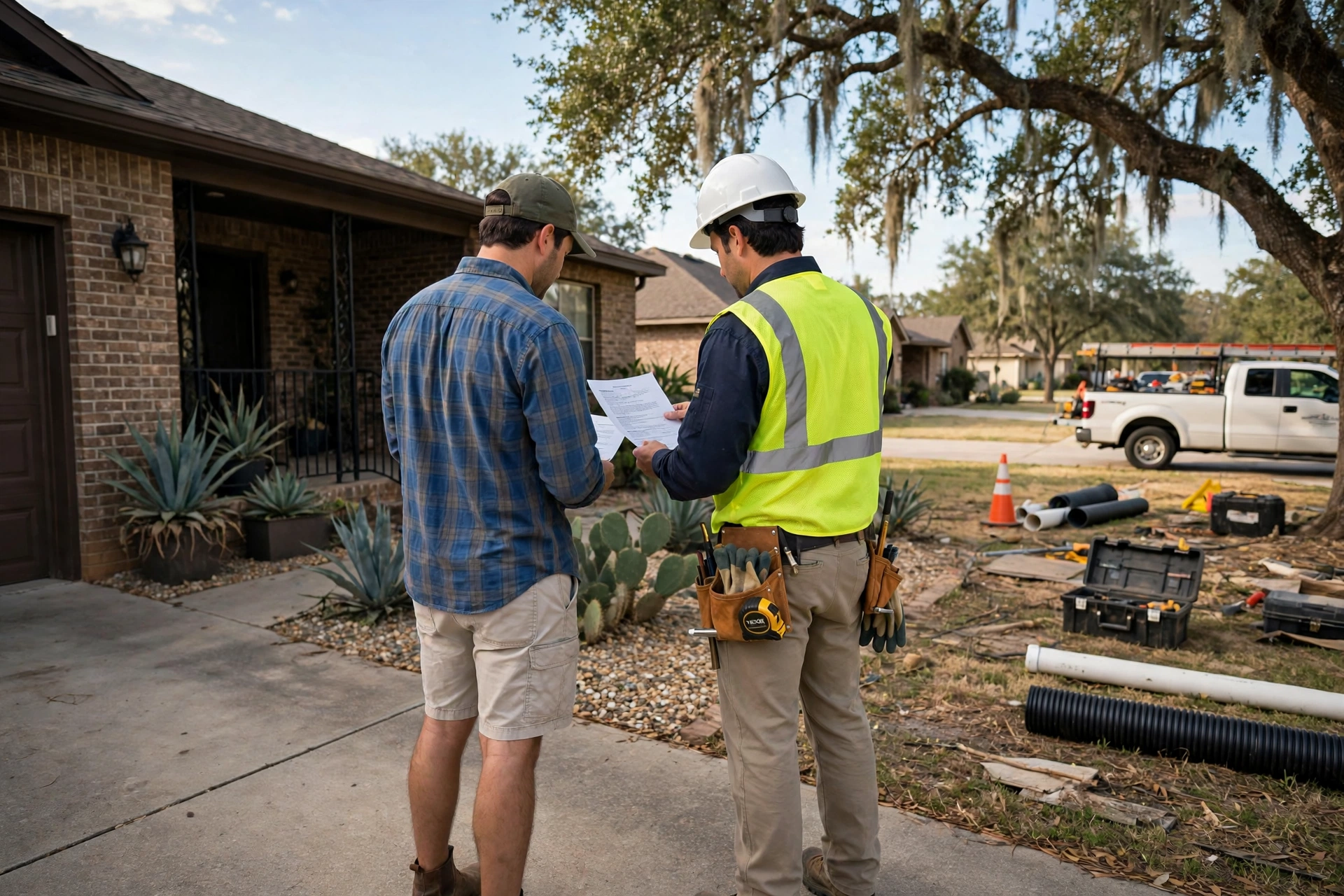
- Get the camera report first. Any replacement quote without footage of your line is a guess. The report should name the damage type, location, and extent.
- Get at least two written quotes on the same scope. Same method, same length, same restoration inclusion — otherwise you’re comparing different jobs.
- Ask for the line items. Pipe, labor, excavation, permits, restoration, cleanout — each on its own line. Vague lump sums hide the surprises.
- Ask what could change the price. Soil conditions, depth surprises, additional damage found during the work — a good contractor names these up front.
- Check what’s excluded. Restoration, permits, haul-away, and post-repair camera verification should each be explicitly included or excluded, not left ambiguous.
- Never decide under pressure. A sewer line that needs replacement has usually needed it for months; a contractor demanding a same-day decision is selling urgency, not plumbing.
For general detection pricing context, see how much leak detection costs in Kyle TX.
Frequently Asked Questions
How much does sewer line replacement cost in Kyle TX?
No Kyle-specific pricing is published. Borrowed Texas-wide ranges put full replacement at roughly $3,500–$14,250 for most residential jobs (Houston guides), with Angi Austin showing up to $33,000 for long, deep, or complex runs. Your exact quote depends on length, depth, soil, what’s above the line, and method — confirm it on the call after a camera inspection.
Is trenchless replacement cheaper than digging?
Per foot, trenchless usually costs more. In total, often not — because digging adds excavation labor and restoration (lawn, driveway, sidewalk) that trenchless mostly avoids. Compare complete written totals including restoration.
How long does a sewer line replacement take?
Trenchless jobs often finish in 1–2 days. Traditional digs take several days for the pipe work, plus restoration time afterward (concrete curing, sod establishment). Weather and soil conditions can extend either.
Do I need a permit for sewer line replacement?
Typically yes — borrowed Houston figures put permit and inspection fees at $200–$475, usually handled by the contractor. Confirm your contractor includes permits in the quote.
Can I replace only part of the line?
Yes, when the damage is localized — borrowed Houston spot-repair/partial replacement ranges run $1,425–$3,800. The camera report determines whether a partial fix is honest or whether the rest of the line will fail next. Repeated partial repairs on a failing line cost more than one replacement.
Get the Number Based on Your Actual Line
A sewer line replacement cost question can’t be answered honestly without seeing your pipe — its length, depth, damage, and what’s sitting on top of it. Any number given before a camera inspection is a guess, and guesses are how sewer jobs go over budget.
Call Kyle Leak Detection Pros at (512) 729-5265 for sewer leak detection in Kyle TX — camera inspection, yard locate, and a written report, so your replacement quote is built on evidence.