Vinyl Liner Pool Leak in Kyle TX: Tears, Seams and Dye Testing (2026)
Vinyl liner pools leak differently from plaster or fibreglass pools, and that difference matters for diagnosis. The liner is a flexible sheet fitted inside the pool structure, sealed at fittings and held at the top by a bead or track where it meets the coping. A vinyl liner pool leak is usually a hole, tear,…
Vinyl liner pools leak differently from plaster or fibreglass pools, and that difference matters for diagnosis. The liner is a flexible sheet fitted inside the pool structure, sealed at fittings and held at the top by a bead or track where it meets the coping. A vinyl liner pool leak is usually a hole, tear, or seam failure in that sheet — small, sometimes tiny, and often in exactly the places where the liner is cut, folded, or fastened. Finding it is a different job from finding a crack in a rigid shell, and this guide explains how.
If your Kyle liner pool is losing water and you can see a tear, a wrinkle near a fitting, or a level that keeps falling, call (512) 729-5265 to book pool leak detection. A liner hole does not heal, and every refill cycle sends more water behind the liner. For the first checks that separate evaporation from a real leak, see our post on pool leak signs in Kyle TX.
How a Vinyl Liner Is Fitted — and Where It Fails
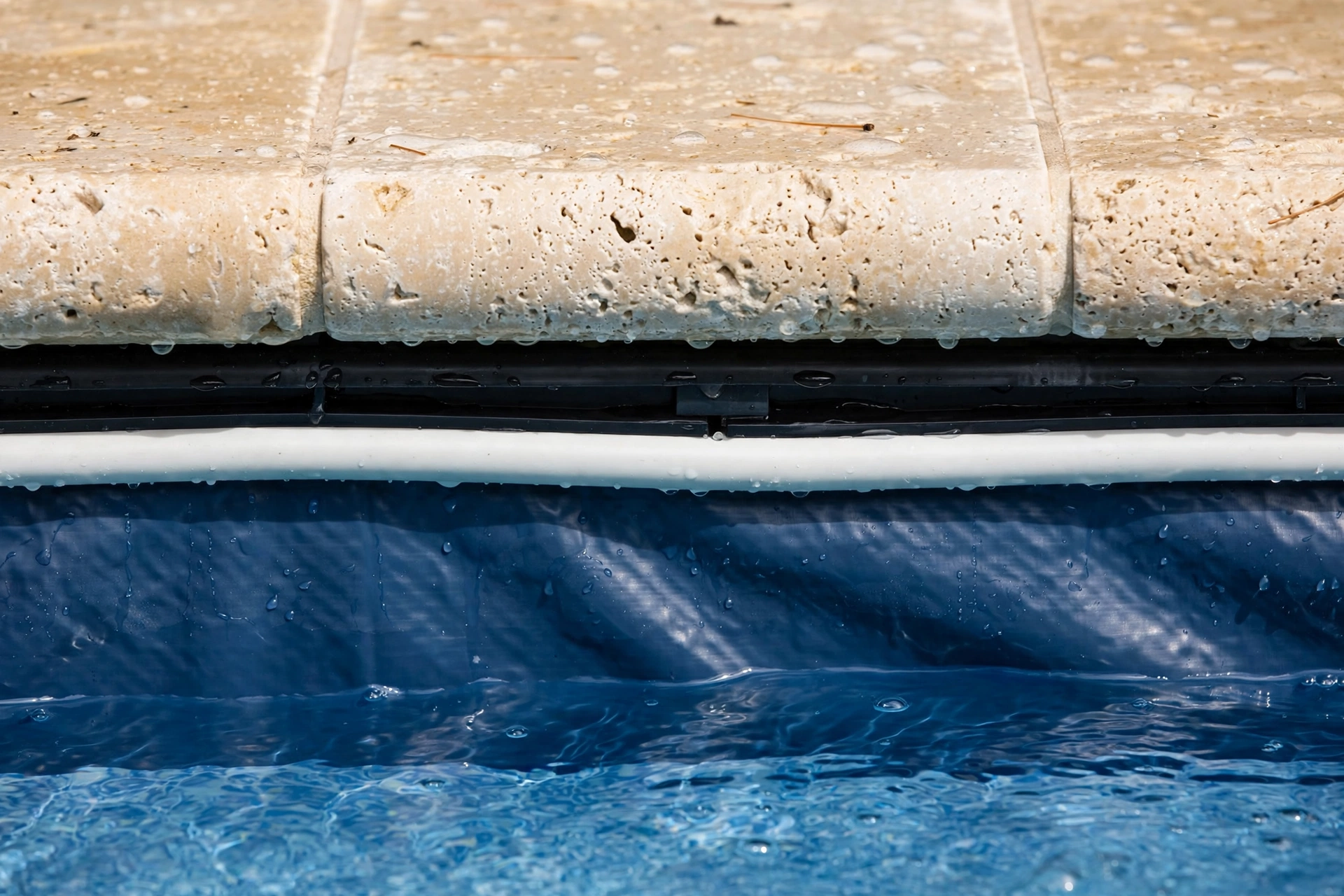
A vinyl liner is a custom-sized sheet that lines the pool’s walls and floor, held in place by a bead that locks into a track at the top of the wall, just under the coping. Around every penetration — skimmer, returns, lights, steps, main drain — the liner is cut and sealed with a faceplate and gasket, much like the fittings in a rigid pool. Seams join the liner’s panels, and the floor of the liner rests on the pool base.
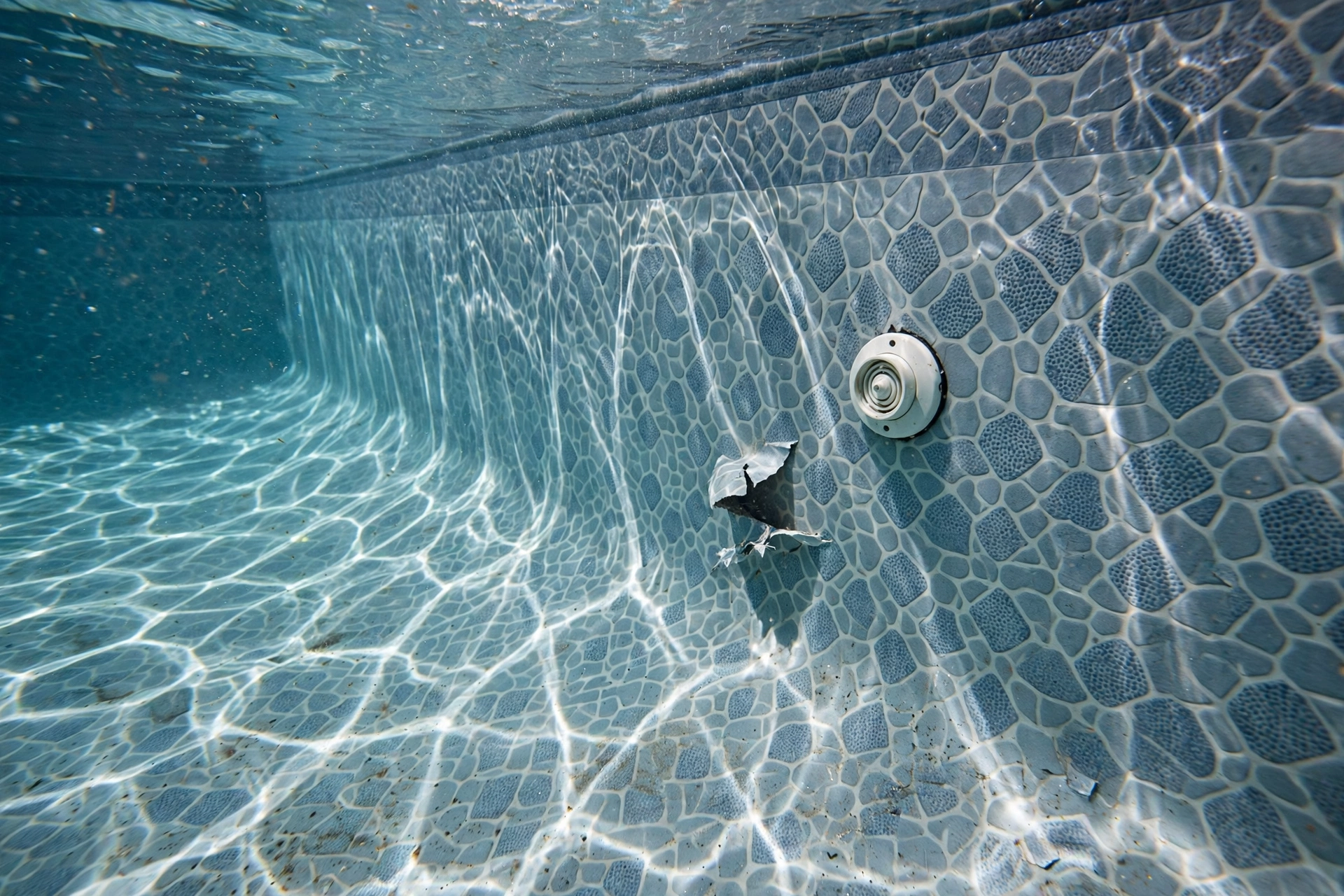
Each of those features is a potential leak point, and the pattern is consistent across sources: tears and holes occur most often around fittings, where the liner is cut and fastened; at steps and corners, where it is folded and stressed; and where the liner meets the coping, where the bead can pull free or the liner can wear. The flat middle of a wall or floor panel is a less common failure point, unless something sharp has damaged it. Knowing that pattern already narrows the search: a vinyl liner pool leak is most likely at an edge, a fitting, or a seam, not in the middle of nowhere. That edge-and-fitting pattern is what makes a vinyl liner pool leak a search with a shortlist, not a blind hunt.
Tears Around Fittings: The Most Common Liner Leak
Fittings are the prime suspects in a liner pool because each one is a hole cut in the liner, sealed by a gasket and faceplate. Age, chemical exposure, and movement can harden or shrink a gasket, loosen a faceplate, or stress the liner around the cut. A tear often starts as a tiny split at a screw hole or at the edge of a faceplate, then grows as water pressure works at it.
The signs are similar to fitting leaks in other pools, with a liner twist: the level-stop clue applies here too. Water falls until it reaches the leaking fitting’s height, then slows or stops, because water below that height no longer presses against the breach. A level that settles at a return or light fitting, or at skimmer height, points at that fitting’s liner seal. Our post on pool light leaks in Kyle TX explains the same level-stop logic for light niches, and the fitting principle carries over to liner pools: dye testing at the fitting confirms it, as described below.
Around the skimmer, a liner pool has an extra failure mode: the liner must be seated cleanly behind the skimmer faceplate, and a wrinkle, tear, or poor seating near the opening can let water through behind the wall. A faceplate that moves when pressed gently, or a visible wrinkle radiating from the skimmer mouth, deserves attention. Do not force a faceplate or overtighten its screws — cracking the plate turns a seal problem into a parts problem. That skimmer-mouth wrinkle is exactly the kind of detail that confirms a vinyl liner pool leak before dye ever touches the water.
Seams, Corners, Steps, and the Coping Line
Seams are the second classic liner failure. Liner panels are joined by welded seams, and a seam can separate or develop a pinhole, particularly where it runs over a step edge or around a corner that flexes. A seam failure may leak slowly and steadily, without the dramatic level-stop pattern of a fitting leak, because a floor seam sits below the water at all times. A level that falls slowly and never stabilises, with no fitting suspect, should raise seams as a possibility.
Steps deserve their own check: the liner is folded over step edges, and foot traffic, cleaning equipment, and toys stress those folds. A tear at a step corner is common and often visible once you look for it. At the top of the wall, the liner bead locks into its track under the coping. If the bead pulls free, the liner can slip, wrinkle, and leak at the top edge — and a liner that has slipped is also at risk of further damage if the pool is used while it hangs loose. A bead that has come out of its track should not be forced back by hand under tension; note it and report it when you book. Those folded step edges are a classic place for a vinyl liner pool leak to hide in plain sight.
Wrinkles Versus Leaks: Not Every Wrinkle Is a Hole
Liner pools wrinkle, and wrinkles worry owners — but a wrinkle is not automatically a leak. Wrinkles form when the liner shifts slightly, often after chemical imbalance, temperature change, or groundwater pressure behind the liner. A wrinkle on a wall or floor that is not near a fitting or seam, with no water loss beyond evaporation, is usually a cosmetic or fit issue rather than a leak.

The distinction is the water loss itself. A wrinkle plus a falling level needs a leak check; a wrinkle with a stable level does not, on its own, indicate a hole. That said, a wrinkle radiating from a fitting, seam, or step corner is more suspicious, because the same stress that wrinkled the liner may have torn it there. The rule is simple: wrinkles guide where to look, but only water loss and dye testing confirm a vinyl liner pool leak.
How Dye Testing Finds a Liner Hole
Dye testing is the standard confirmation method for liner leaks, and it works the same way it does for other fitting leaks: with the pump off and the water still, dye is released near a suspected tear, seam, or fitting edge, and escaping water pulls the dye into the opening. If there is no leak there, the dye hangs or disperses slowly, and the tester moves on to the next suspect point.
Still water matters more than owners expect. A running pump, recent swimming, or wind stirring the surface can mask a small leak’s pull or suggest one where there is none, so the test needs a quiet pool. The tester works methodically — fitting by fitting, seam by seam — because a liner can have more than one hole, and fixing the first one found while missing a second leaves the pool still losing water. That methodical pass is also why a liner dye test takes time: the liner’s whole wetted surface is, in principle, suspect, and the tester narrows it by pattern first (fittings, seams, steps, coping) and by dye second. For a homeowner-friendly walkthrough of the same dye-test method, see Angi’s guide to finding a leak in a pool.
Homeowners can help by noting where the level stops, if it stops, and by photographing any visible tear or wrinkle near a fitting before the visit. Do not apply sealants or patches before the test: a patch over the wrong spot hides the dye evidence and can trap water behind the liner.
Patch Versus Replacement: How to Think About It
A small, well-defined tear or hole is often handled with a patch, prepared and applied so it bonds under water and holds over time. Patching is a local repair: it seals the breach without disturbing the rest of the liner. A larger problem — a long seam separation, widespread tearing, or a liner that has slipped extensively from its track — may need a larger section repair or a full liner replacement, which is a different scale of job entirely.
This guide attaches no invented lifespan to patches and no price to either option. Patch life depends on material, preparation, water chemistry, and whether the underlying cause was addressed, and replacement cost depends on pool size, liner type, and access — none of which can be honestly fixed in a general article. As a borrowed general reference only, pool leak repairs are reported at $150–$5,000 by severity and location (lonestarpoolcleaning.com). No liner-specific repair price is published or verified here, and none is offered. Your exact price is confirmed on the call, once the failure point and scope are known.
What Not to Do With a Suspect Liner Leak
Do not drain the pool to “see better.” An empty vinyl liner pool risks the liner shrinking, shifting, or pulling from its track, and groundwater pressure can push a liner out of place when the water weight is gone. Dye testing works with the water in place and does not need an empty pool. Do not pull a slipped bead back under tension, force a faceplate, or apply sealant over a suspected tear before testing — each of these can hide evidence or worsen the damage.
Do keep the autofill off and log the level daily with a tape mark and the date, so the technician can see the rate of fall and whether it stops at a fitting height. Note any visible tear, wrinkle, or slipped bead with a photograph. November is pool off-season in Central Texas, which suits liner diagnosis: still water, no swimmers, and a clear read on the level over several days. A liner leak confirmed now can be patched on your own timetable before spring, rather than discovered when you want the pool back in use.
The Bottom Line
A vinyl liner pool leak is usually a tear, seam failure, or fitting-seal failure at an edge, a fitting, or a seam — not a mystery in the middle of a panel. The level-stop clue points at the height, dye testing with still water confirms the point, and a small hole is typically a patch while a large failure is a bigger job. Wrinkles guide the search but only water loss and dye confirm the leak. That pattern-first approach is how a vinyl liner pool leak gets found without draining the pool.
If your liner pool keeps losing water, or you can see a tear near a fitting, call (512) 729-5265 to book pool leak detection. Tell us where the level stops and photograph anything torn or slipped — that is what turns a vinyl liner pool leak from a whole-pool worry into one confirmed point. For the question that comes before any of this — evaporation or leak — see our post on pool evaporation versus leak.
Frequently Asked Questions
How do I know if I have a vinyl liner pool leak?
The strongest clues are a water level that falls beyond evaporation (confirmed by the short bucket-test comparison in our signs post), a level that stops at a fitting height, or a visible tear, wrinkle, or slipped bead near a fitting, seam, or step. Dye testing with the pump off and water still confirms the exact hole.
Can a vinyl liner pool leak be patched without draining the pool?
Often, yes. Small, well-defined tears are commonly patched underwater, and dye testing itself works with the pool full. A larger seam failure or a liner that has slipped extensively may need a bigger repair, which is scoped after the failure point is confirmed.
Does every wrinkle in a vinyl liner mean a leak?
No. Wrinkles form from liner shifting, chemical imbalance, temperature change, or groundwater pressure, and a wrinkle with a stable water level is usually a fit issue rather than a hole. A wrinkle plus falling water, especially near a fitting or seam, needs a leak check.
Should I drain my vinyl liner pool to find a leak?
No. Draining risks the liner shrinking, shifting, or pulling from its track, and groundwater pressure can push it out of place without the water’s weight. Dye testing works with the water in place and is the right confirmation method.
How much does fixing a vinyl liner pool leak cost?
No Kyle-specific or liner-specific repair price is published or verified, so this article does not quote one. As a borrowed general reference only, pool leak repairs are listed at $150–$5,000 by severity and location (lonestarpoolcleaning.com). Your exact price is confirmed on the call, once the failure point and scope are known.