

Sewer Smell in Your House or Yard in Kyle TX: Causes and Fixes (2026)
Sewer Smell in Your House or Yard in Kyle TX: Causes and Fixes (2026) A sewer smell is the kind of problem that makes you doubt yourself. You open a window, it fades. You close the house up, it comes back. Nobody can quite agree which room it is coming from, and nothing is backing…
Sewer Smell in Your House or Yard in Kyle TX: Causes and Fixes (2026)
A sewer smell is the kind of problem that makes you doubt yourself. You open a window, it fades. You close the house up, it comes back. Nobody can quite agree which room it is coming from, and nothing is backing up, so it is easy to put off. That is a mistake. A persistent sewer odor usually means something is open, dry, blocked, or broken — and the difference between a five-minute fix and a broken line underground is worth finding out properly.
This guide walks through a sewer smell house problem step by step for Kyle TX: how to narrow down where the smell is coming from, the inexpensive fixes to try first, the signs that point to a broken line, and when a camera inspection is the only honest next step. No Kyle-specific pricing is published for this work, so any dollar figures below are borrowed Texas-wide ranges, labeled as borrowed — your exact price is confirmed on the call.
If the smell is strong, constant, or paired with slow drains, gurgling toilets, or backups, do not just live with it. Call (512) 729-5265 for sewer leak detection in Kyle TX — sewer gas is a health concern, not just an unpleasant odor, and a smell plus other symptoms usually means the line itself needs looking at.
Sewer Smell House Triage: Narrow It Down Before You Fix Anything
A sewer smell house investigation starts with three questions. Answer them before you buy anything or call anyone, because the answers point to completely different causes.
Inside or outside? Walk the yard, especially after rain and near cleanouts and any unusually green or soggy patch of lawn. Then go back inside, room by room. A smell strongest in the yard points toward the buried line. A smell strongest in one bathroom points toward that bathroom’s trap, seal, or vent. A smell everywhere inside points toward a vent problem or a main-line issue.
One fixture or the whole house? A smell at a single sink, shower, or toilet usually means a local problem at that fixture. A smell at every drain points toward the main line or the vent stack serving the whole house. Local problems have local fixes; whole-house smells need the main line checked.
Constant, or worse at certain times? A smell worse after rain can mean a yard line leak, because moist soil traps sewer gas and pushes it upward. A smell when a fixture is used can mean a seal that fails under flow. A smell that is constant, day and night, is more likely a broken line or a permanently dry or open connection.
Inside the House: The Cheap Fixes First
Many indoor sewer smells come from small, fixable problems. Work through these in order, cheapest first, and stop when the smell is gone.
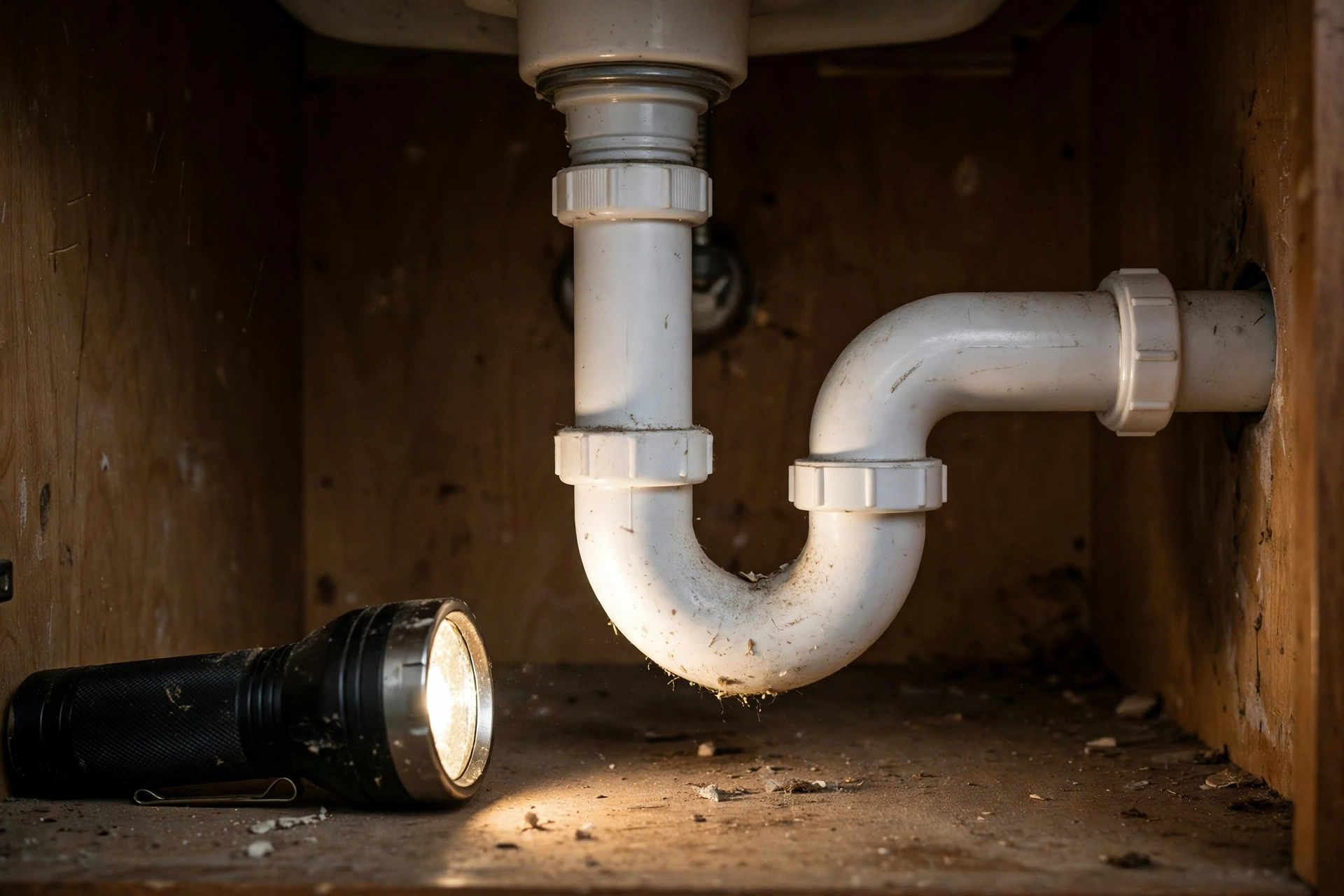
A dried-out drain trap. Every drain has a U-shaped trap holding water, and that water is the seal stopping sewer gas from entering the room. A rarely used drain — a guest bathroom, a basement floor drain — lets its trap water evaporate, and the seal disappears with it. Run water into the drain for a minute to refill the trap. For slab-related clues, see the slab leak guide for Kyle TX. If it returns within days, the trap may be leaking, siphoning dry, or cracked, and that needs a plumber, not more water.
A blocked or damaged vent. Plumbing vents run up through the roof, letting sewer gas escape outside and air into the drains. A vent blocked by leaves or debris can push gas back into the house and cause gurgling drains. A vent pipe cracked or disconnected in an attic or wall can leak gas indoors directly. Do not climb onto a roof yourself to clear a vent unless you are comfortable and equipped to do so safely — a blocked vent is a job for a professional with the right access.

A failed toilet wax ring or drain seal. The wax ring under a toilet seals it to the drain flange. When it fails, sewer gas escapes around the base, and the smell is strongest right at the toilet. Signs include a toilet that rocks slightly or staining at the base. Replacing a wax ring involves removing and resetting the toilet, so it is not a casual job if the flange or subfloor is damaged underneath.
A cracked or loose drain connection. Under sinks and behind showers, a loose joint, cracked trap, or disconnected drain lets gas out exactly where you smell it. Look for dampness or staining under the fixture where the smell is strongest. A cracked trap or a drain that was never properly connected needs repair, and a smell that persists after the obvious joint is fixed points elsewhere.
Outside the House: When the Yard Smells Like Sewage
A sewer smell in the yard should be taken more seriously than a smell in one bathroom. The buried sewer line does not normally announce itself. When you can smell it outside, something is open or leaking underground.
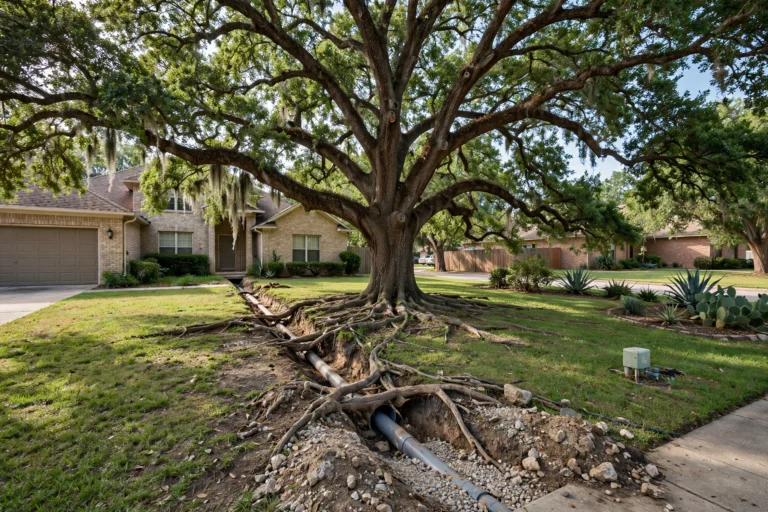
Walk the likely path of the line from the house to the street and look for an unusually lush patch of grass, a soggy area that stays wet when the rest of the yard is dry, a sunken spot, or a cleanout cap that is loose or missing. A smell stronger after rain fits a yard line leak, because wet soil holds gas close to the surface. A smell near a cleanout can mean the cap seal has failed — an easy fix — but it can also mean pressure in the line is finding the easiest exit, which points back to a blockage or break downstream. A sewer smell house complaint that is strongest outdoors should never be dismissed as a neighbor’s problem.
When a Sewer Smell Means a Broken Line
Treat the smell as a broken-line suspect when any of these are true: the smell is constant and present at multiple drains; it comes with slow drains throughout the house, gurgling, or backups that return after cleaning; it is strongest in the yard, especially after rain; it started after ground movement, nearby excavation, or foundation work; or it is paired with a damp area near the slab or new cracks suggesting soil movement. Long-term sewer leaks can erode soil under foundations, so a smell plus structural clues should not be separated into two unrelated problems. If several of these signs fit your sewer smell house situation, treat the camera inspection as urgent rather than optional.
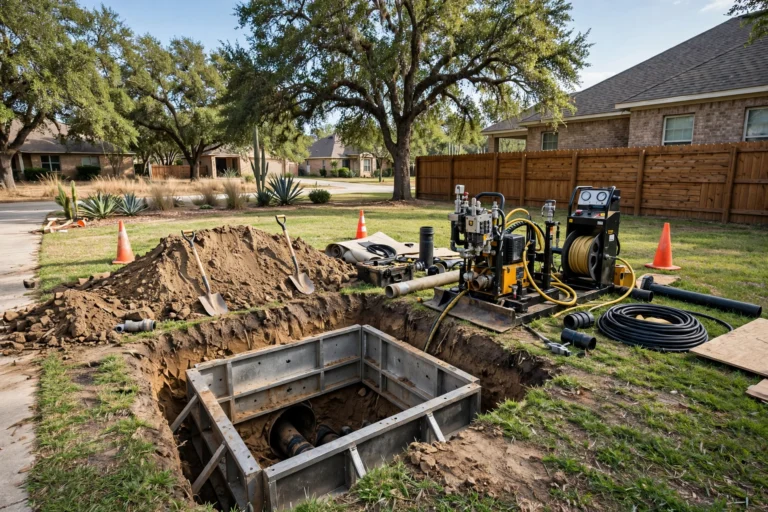
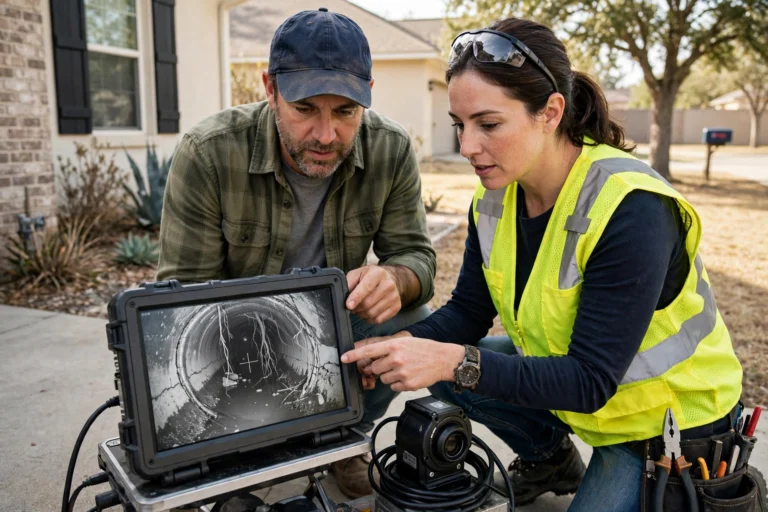
A broken line is confirmed one way: a camera inspection. The camera shows cracks, separated joints, root entry points, bellies, and collapses directly, and the locate marks the spot so a repair can be targeted. In some cases a hydrostatic test checks whether a line under a slab holds water, as described in the hydrostatic pressure test guide — a professional will advise which is appropriate for your situation.
Borrowed Texas-wide ranges put a sewer camera inspection at roughly $125–$500 (Houston-area guides) to $260–$1,700 (Angi Austin data, depending on length, access, and reporting). Those are borrowed ranges, not Kyle quotes. Your exact price is confirmed on the call at (512) 729-5265.
Frequently Asked Questions
Why does my house smell like sewer but nothing is backing up?
A sewer smell house problem does not need a backup to be real. The most common causes without a backup are a dried-out drain trap, a blocked vent, a failed toilet wax ring, or a cracked or broken sewer line leaking gas underground. The triage is inside vs outside, one fixture vs whole house, and constant vs after rain — that pattern separates a trap fix from a line problem that needs a camera.
How do I find where a sewer smell is coming from?
Start with the three triage questions: inside or outside, one fixture or the whole house, and when it is worst. Refill any rarely used drain traps with water and check the toilet base and under-sink connections for the indoor causes. If the smell is in the yard, whole-house, or paired with slow drains and gurgling, it needs a professional camera inspection — do not dig in the yard to find it yourself.
Can a dry P-trap cause a sewer smell house problem?
Yes, and it is the cheapest cause to check. The water in a P-trap is the seal against sewer gas, and in a rarely used drain that water evaporates. Running water into the drain refills the trap and should clear the smell. If the smell returns within days, the trap may be leaking or siphoning dry, and that needs repair rather than repeated refilling.
Is sewer smell in a house dangerous?
It can be. Sewer gas irritates eyes and airways and can cause headaches and nausea, and a strong or constant smell should not be masked and ignored. Ventilate, keep people out of the worst-affected room, and get the cause found. A faint odor from a dry trap is low risk once fixed; a strong, constant smell needs prompt professional attention. The EPA’s guidance on resolving septic system malfunctions notes that sewage may contain harmful pathogens and advises avoiding contact and wearing protective clothing during cleanup.
When should I get a camera inspection for a sewer smell?
When the smell is whole-house, constant, or in the yard; when it comes with slow drains, gurgling, or recurring backups; when the cheap fixes — trap refill, seal checks, vent inspection — have not solved it; or when it started after ground movement or nearby digging. Call (512) 729-5265 to book one.
Do Not Mask It — Find It
A sewer smell house problem is your sewer system asking for attention in the only language it has. Refill the dry trap, check the seals, and look at the vent — and if the smell is whole-house, constant, or in the yard, get the line camera-inspected before a smell becomes a backup. Every sewer smell house investigation ends the same way: find the source, fix the source, and confirm it with a camera when the cheap fixes do not work.
Call Kyle Leak Detection Pros at (512) 729-5265 for sewer leak detection in Kyle TX — camera inspection, yard locate, and written findings, with your exact price confirmed on the call.