
Pool Evaporation vs Leak in Kyle TX: How to Tell the Difference (2026)
Every pool owner in Central Texas has asked it, usually while staring at a waterline that seems lower than yesterday: is this evaporation, or is my pool leaking? It is the most common pool question across every source, and it matters, because the two answers lead to opposite actions. Evaporation needs a top-off and patience….
Every pool owner in Central Texas has asked it, usually while staring at a waterline that seems lower than yesterday: is this evaporation, or is my pool leaking? It is the most common pool question across every source, and it matters, because the two answers lead to opposite actions. Evaporation needs a top-off and patience. A leak needs a detection visit before it quietly wastes water, undermines soil, and grows into a bigger repair. This guide answers the pool evaporation vs leak question for Kyle TX pools with the two tests that actually separate them: what normal evaporation looks like here, and the pump-on/pump-off isolation test.
If your tests point to a leak rather than the weather, call (512) 729-5265 to book pool leak detection. For the full first-check walkthrough, including signs beyond water loss, see our post on pool leak signs in Kyle TX.
What Normal Evaporation Looks Like in Central Texas
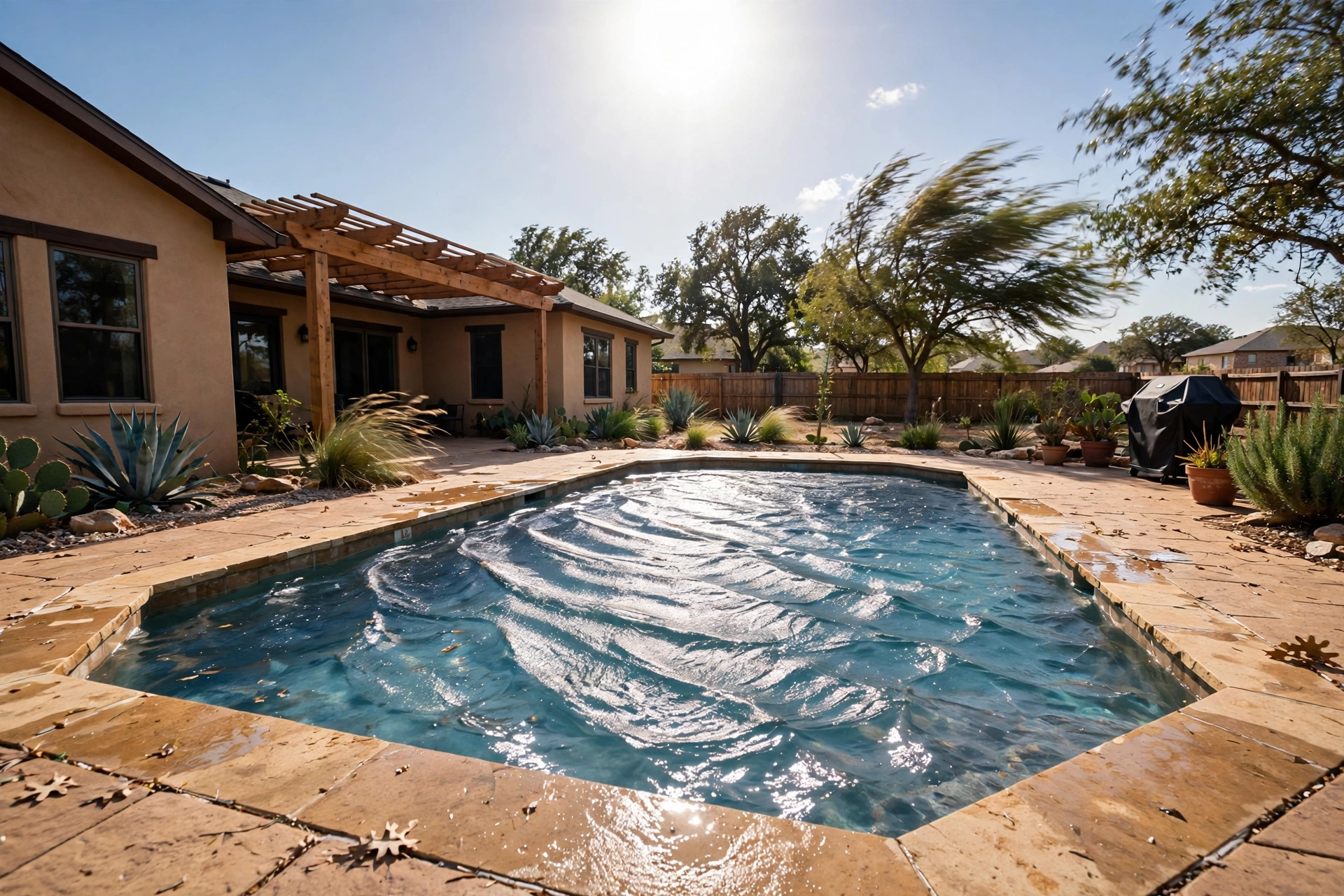
Published pool sources agree that normal pool evaporation is roughly ¼–½ inch per day, and that the rate rises in hot, dry, windy weather — exactly the conditions Central Texas delivers for much of the year. A pool can therefore lose a visible amount of water in a week without anything being wrong: at ¼ inch a day, that is nearly 2 inches a week; at ½ inch a day in a hot, windy stretch, it is 3½ inches a week. Those numbers are the baseline everything else is judged against.
Several factors push a pool toward the high end of that range. High air temperature and low humidity pull moisture from the surface faster. Wind across the surface strips the humid air layer above the water and accelerates loss. A heated pool loses more than an unheated one, and a pool with water features — waterfalls, fountains, spillovers — loses extra water to splash and aeration. Heavy swimming also removes water through splash-out, and backwashing the filter discharges water by design. None of these is a leak, but all of them lower the level, and all of them must be accounted for before a leak is declared. Those factors are why the pool evaporation vs leak question needs a test, not a guess.
The warning sign is loss clearly beyond that range, or loss that does not behave like weather. A pool dropping an inch a day in mild, calm weather, or losing water steadily through a cool, humid week when evaporation should be low, is not behaving like evaporation. Neither is a pool that needs topping off every day or two regardless of weather. When the loss exceeds roughly ½ inch a day sustained, or when it stays high while conditions are mild, the pool evaporation vs leak question starts to answer itself: it is probably a leak, and the tests below confirm it.
The Bucket Test, in Brief — Full Steps Linked, Not Repeated
The classic first check is the bucket test, covered in full in our seed post. In short: a bucket of pool water on a step is compared with the pool level after about 24 hours with the pump and autofill off — a pool drop clearly larger than the bucket drop points to a leak. For the full steps, see our pool leak signs post.
The bucket test answers one question — leak or evaporation — and no more. It cannot say where the water is going, which is why a positive bucket test is the start of a diagnosis, not the end of one. The pump-on/pump-off test below is the next step, because it narrows the leak to a side of the system before any professional visit. For a homeowner-friendly walkthrough of the bucket test and other leak checks, see Angi’s guide to finding a leak in a pool.
The Pump-On / Pump-Off Isolation Test
This test separates plumbing leaks from shell and fitting leaks, and it is the most informative check a homeowner can run without equipment. Pool plumbing divides into pressurised lines, where the pump pushes water out to the returns, and suction lines, where it draws water in from the skimmer and drain. A leak in a pressurised line usually loses water faster while the pump runs, because the system is under pressure then, and slows when the pump is off. A leak in the shell, a fitting, or a structural crack often loses water at a similar rate regardless of the pump, because gravity and water pressure act on it either way.
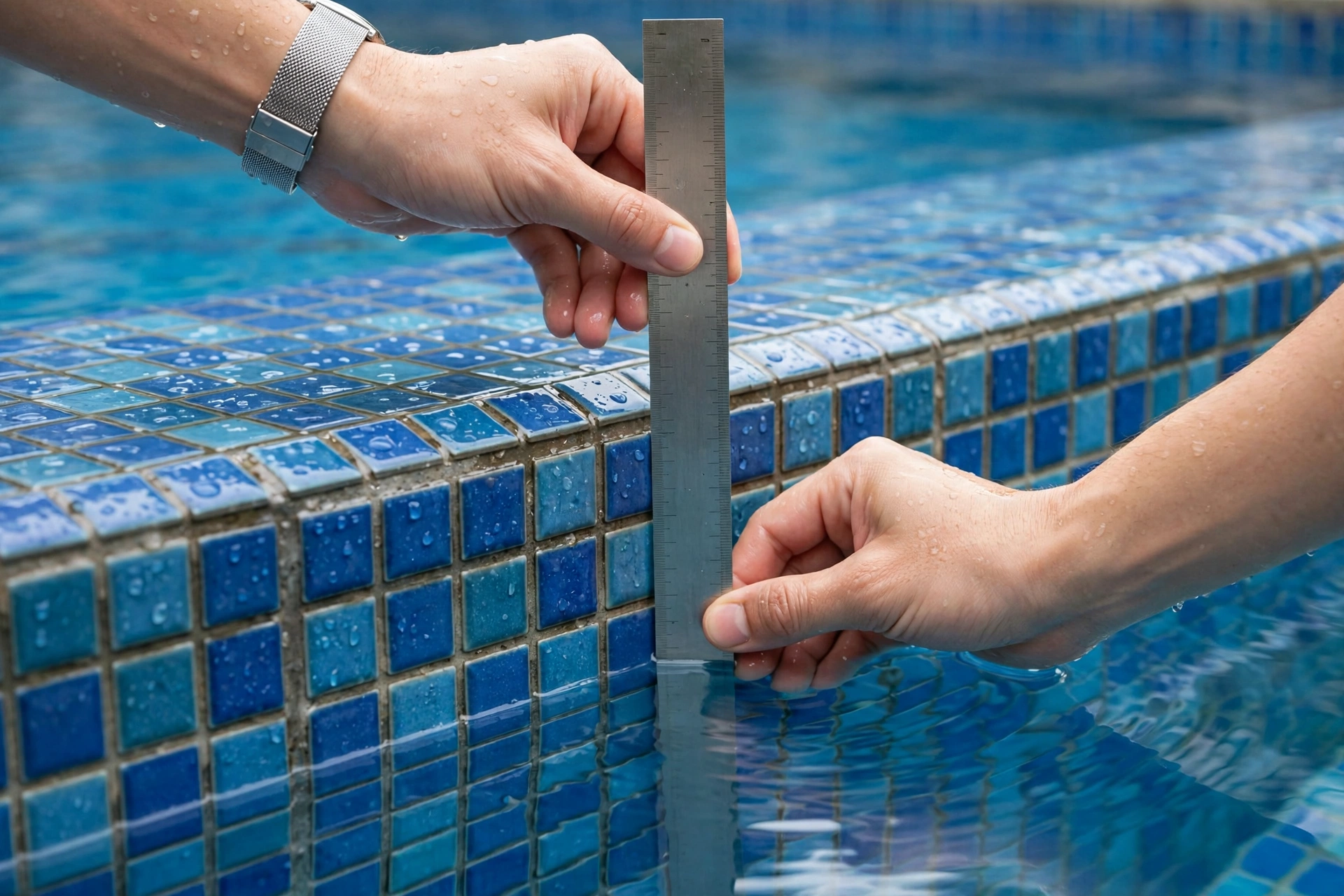
To run it, turn off the autofill and mark the level with the date and time. Measure the drop over 24 hours with the pump running normally, without swimming, backwashing, or adding water. Then repeat for 24 hours with the pump off under similar weather. Compare the two rates, not just the totals: weather differs between days, so a small difference may be noise, but a clear difference — much faster loss with the pump on — points toward the pressurised plumbing, while similar loss in both states points toward the shell or a fitting. That side-by-side comparison is the sharpest tool in the pool evaporation vs leak question.
Record both readings with dates and weather notes, and report them when you book. That pair of numbers tells a technician where to start testing, and it can save a visit’s worth of searching. If the pump-on loss is clearly faster, the search starts with the return lines and pressurised joints; if the loss is the same either way, it starts with the shell, fittings, and drain assembly. Either way, the pool evaporation vs leak question is now answered with data, not a feeling.
The Level-Stop Clue: Where the Water Stops Tells You Where to Look
A third home observation costs nothing and often identifies the leak’s height. Water can only escape from a point that is under water, so a falling level that stops at a line and holds there points to a breach at that height. A level that drops and holds at the skimmer mouth points to the skimmer area. One that falls past the skimmer and holds at the lights points to the light niches or fittings at that height. One that keeps falling past every fitting points to the lowest part of the system: the main drain and its line.
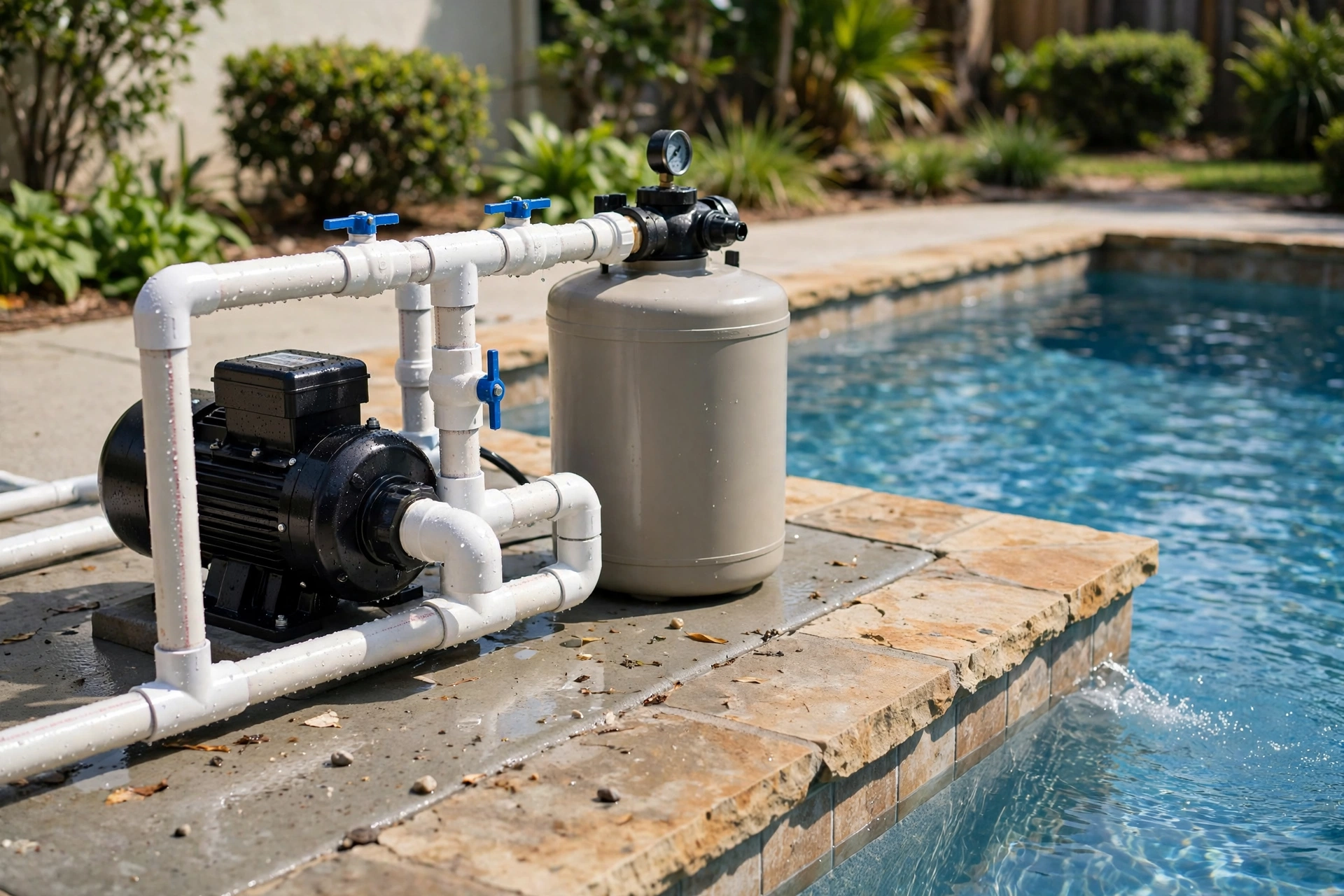
To read it, mark the level daily with the date and time, keep the autofill off, and do not add water between readings. A level that falls and then holds repeatedly at the same line, refill after refill, is a strong pattern — far stronger than a single day’s drop, which weather can explain. Combine it with the pump-on/pump-off result: a level that stops at a fitting height and loses faster with the pump on points one way; a level that never stops and loses the same either way points another. Together, these two home tests give a technician a starting point that is worth more than a vague “it keeps losing water.” That repeating pattern settles the pool evaporation vs leak question better than any single day’s drop.
When It Is Evaporation After All — and When to Stop Guessing
Sometimes the tests clear the pool, and that is a useful answer too. A bucket test showing pool and bucket dropping together, a level loss inside the ¼–½ inch daily range, and loss that rises and falls with heat and wind all point to evaporation. In that case, the right actions are mundane: keep the autofill working, consider a pool cover to cut evaporation (covers reduce surface loss substantially in published guidance), and recheck after a hot or windy stretch rather than worrying daily.
But there is a point where home testing should stop and a professional visit should start. If the bucket test clearly shows a leak, if the level falls well beyond ½ inch a day sustained, if the level-stop pattern repeats at a fitting, or if the pump-on/pump-off comparison clearly favours the plumbing — book the visit rather than running more home tests. Home tests locate the problem’s side and height; they cannot pressure-test a buried line or dye-test a fitting, and continuing to top off a leaking pool while testing wastes the very water the leak is losing. For what a confirmed leak costs to find, borrowed Texas detection ranges run $300–$550 in Tyler TX and $250–$400 generally — borrowed figures, not Kyle quotes; your exact price is confirmed on the call. See our pool leak detection cost guide in Kyle TX for the full borrowed-range picture.
November is pool off-season in Central Texas, and that is a practical advantage for this whole question: still water, no swimmers, and mild weather make both home tests cleaner to read, and a leak confirmed now can be repaired on your own timetable before spring, rather than discovered when you want the pool back in use.
The Bottom Line
Pool evaporation vs leak is answerable without guessing: normal Central Texas evaporation runs roughly ¼–½ inch a day, rising with heat, wind, and low humidity; the bucket test separates evaporation from a leak; the pump-on/pump-off test separates plumbing from shell; and the level-stop pattern points at the leak’s height. A pool inside the evaporation range, behaving with the weather, is fine. A pool beyond it, or with a repeating level-stop pattern, needs a detection visit. Those four checks together answer the pool evaporation vs leak question with data, not a feeling.
If your tests point to a leak, call (512) 729-5265 to book pool leak detection, and bring your numbers: the bucket comparison, the pump-on and pump-off drops, and where the level stops. Those three readings turn a pool evaporation vs leak worry into a diagnosis a technician can act on the same visit.
Frequently Asked Questions
How much water loss is normal pool evaporation in Kyle TX?
Published sources put normal loss at roughly ¼–½ inch per day, rising in hot, dry, windy weather — conditions Central Texas delivers for much of the year. Loss clearly beyond ½ inch a day sustained, or high loss in mild, calm weather, points away from evaporation and toward a leak.
What is the pump-on/pump-off test for pool evaporation vs leak?
It compares water loss over 24 hours with the pump running normally against 24 hours with the pump off, autofill off, and no swimming or backwashing. Faster loss with the pump on points toward pressurised plumbing; similar loss in both states points toward the shell or a fitting. It narrows the leak’s side of the system before a professional visit.
Does a bucket test tell me where my pool is leaking?
No. The bucket test only answers whether the pool is losing more water than evaporation explains: the bucket loses evaporation alone, the pool loses evaporation plus any leak. Full steps are in our pool leak signs post. Where the leak is comes from the level-stop pattern, the pump-on/pump-off test, and professional pressure and dye testing.
Why does my pool lose more water on windy days?
Wind strips the humid air layer above the water surface, accelerating evaporation, and it also increases splash-out from water features. A windy-day spike that settles when the wind drops is consistent with evaporation; a high loss rate that persists in calm weather is not.
When should I stop testing and book leak detection?
When the bucket test clearly shows a leak, when loss stays well beyond ½ inch a day, when the level repeatedly stops at a fitting height, or when the pump-on/pump-off comparison clearly favours the plumbing. At that point, home tests have done their job, and pressure and dye testing are needed to find the leak itself.