Commercial Slab Leak Detection in Kyle TX: Large Floor Plates (2026)
Commercial slab leak detection often starts with a symptom: there’s a warm patch on your warehouse floor that wasn’t there last month. The water bill is climbing. And somewhere under 20,000 square feet of concrete, a pressurized pipe is leaking. A residential slab leak is a problem. A commercial slab leak is a problem multiplied…
Commercial slab leak detection often starts with a symptom: there’s a warm patch on your warehouse floor that wasn’t there last month. The water bill is climbing. And somewhere under 20,000 square feet of concrete, a pressurized pipe is leaking.
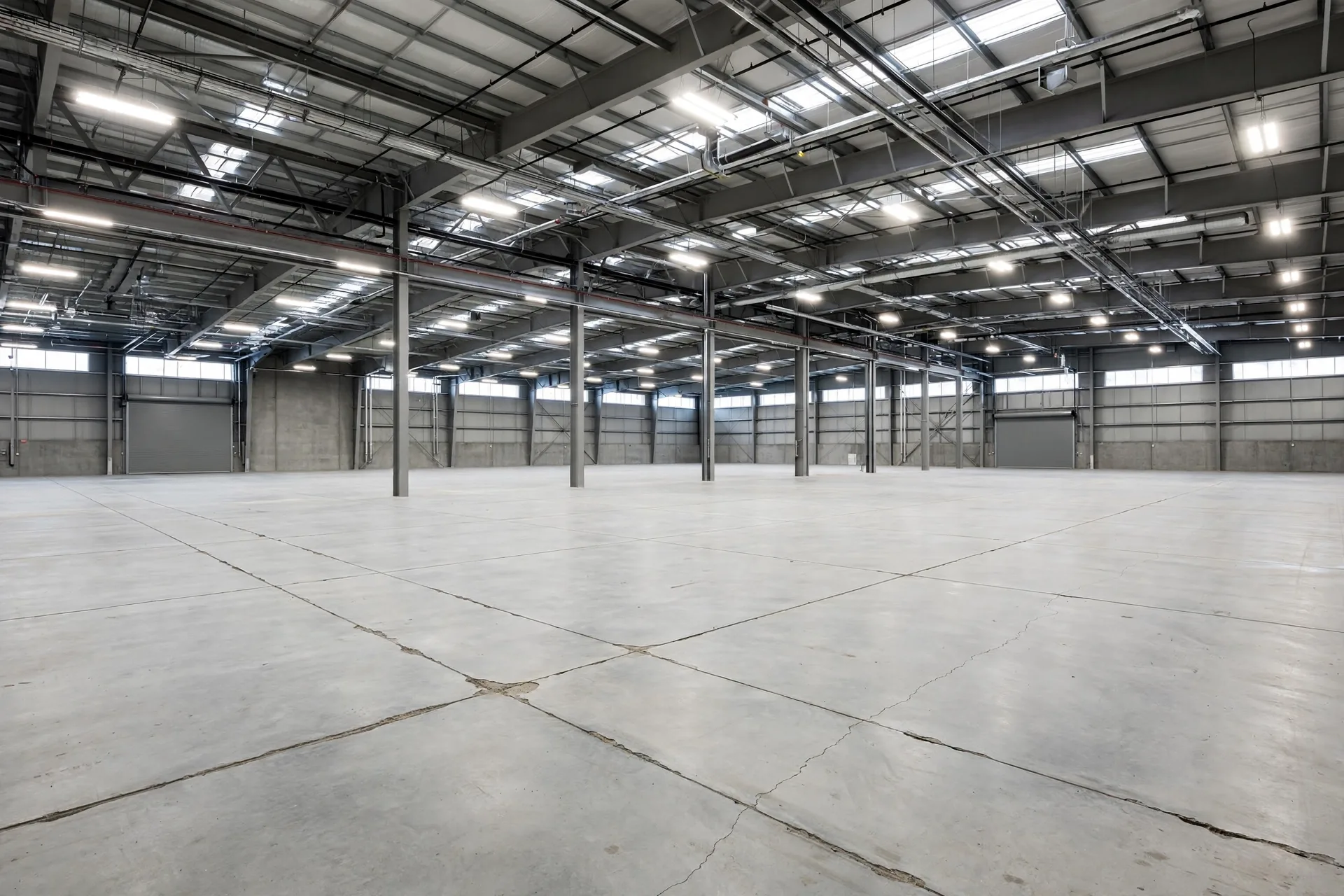
A residential slab leak is a problem. A commercial slab leak is a problem multiplied by square footage, by forklift traffic, by inventory sitting on the floor, and by the fact that shutting down operations for exploratory demolition is not an option. The detection approach is the same science — acoustic listening, thermal imaging, pressure isolation — but the scale, the stakes, and the strategy are entirely different.
This guide covers how commercial slab leaks differ from residential ones, the five signs that point under the slab, how detection works across large footprints, and why detection-first is a business-continuity decision, not just a plumbing one.
The short version: big slabs hide leaks longer and punish guessing harder. Professional commercial leak detection in Kyle TX maps the leak across the full floor plate before anyone breaks concrete — so repairs are phased around your operations. Call (512) 729-5265.
How Commercial Slab Leaks Differ From Residential Ones
Here’s what changes when the slab gets big:
- Bigger plates, longer pipe runs. A home’s under-slab plumbing might run 60–100 feet. A warehouse or retail building can have many hundreds of feet of under-slab pipe — more joints, more footage aging simultaneously, more places to fail.
- Expansion joints and saw cuts. Large commercial slabs are poured in sections with expansion joints. These joints are natural weak points where pipes crossing them flex with every thermal and load cycle. Many commercial slab leaks start at or near a joint.
- Heavy equipment loads. Forklifts, pallet jacks, delivery trucks at loading docks — dynamic loads stress both the slab and what’s under it. A residential slab never sees a 10,000-pound forklift. Yours does, daily.
- Longer hidden duration. In a home, a warm bathroom floor gets noticed in days. In a 30,000-square-foot warehouse, a warm patch in aisle 14 can go unnoticed for months — while the bill climbs and the soil below saturates.
- Business continuity is the real cost. The plumbing repair is the small line item. The big one is downtime: closed aisles, moved inventory, lost operating days. Every decision — detection method, repair method, phasing — has to be weighed against keeping the business running.
5 Essential Signs of a Commercial Slab Leak
1. Warm Spots on the Floor
The hallmark sign, same as residential: a section of concrete noticeably warmer than the surrounding floor, usually indicating a hot-water line leak below. In a commercial building, walk the floor systematically — grid it off if you have to — because “the floor feels warm over there somewhere” isn’t precise enough to act on. Early morning, before HVAC and foot traffic warm the slab, is the best time to check.
2. Unexplained Water Bill Increases
With no irrigation or process-water explanation, a climbing bill plus a big slab equals an under-slab suspect. Commercial meters make this check easy: isolate the building after hours and watch the meter. Movement with everything off means pressurized water is leaving somewhere — and if the building is all slab-on-grade, under the slab is the prime suspect. The WaterSense program also publishes commercial water-efficiency best practices worth reviewing alongside your meter data.
3. Cracks, Heaving, or Settling in the Slab
Kyle’s Blackland clay expands when wet and shrinks when dry. A sustained under-slab leak super-saturates the clay in one zone, and the slab responds: heaving in the wet zone, differential settlement around it. New cracks radiating from one area, a section of floor that’s suddenly not level, doors or dock levelers binding — these are structural symptoms of a water problem below.
4. Musty Smells or Humidity in One Zone
Moisture wicking up through concrete doesn’t always show as liquid water. It shows as persistent humidity in one area, musty odors, condensation on inventory or racking, and in retail or office spaces, complaints about “that damp smell near the back.” If dehumidifiers in one zone run constantly while the rest of the building is fine, look down.
5. The Sound of Running Water With Everything Off
After hours, with HVAC cycled down and the building quiet, stand in the suspect area and listen. A slab leak often produces a faint hiss or rushing sound transmitted through the concrete. In a big building this takes patience — check zone by zone, and compare against a known-quiet area for reference.
Residential vs Commercial Slab Detection: What Changes
| Residential slab | Commercial slab | |
|---|---|---|
| Floor area | 1,500–3,000 sq ft | 10,000–100,000+ sq ft |
| Pipe footage under slab | 60–100 ft | Hundreds of feet |
| Detection time | 1–3 hours | Half day to full day |
| Access constraints | Furniture, occupants | Operations, inventory, safety zones |
| Repair disruption | One household | Revenue, tenants, employees |
| Typical repair approach | Spot repair or re-route | Phased repair, often re-route overhead |
The methods are the same, but the survey is bigger, the logistics heavier, and the report serves more stakeholders: owner, property manager, insurer, sometimes the tenant.
How Commercial Slab Leak Detection Works Across a Large Footprint
A commercial slab leak detection survey follows a disciplined sequence. Here’s what a proper visit looks like:
Step 1 — System isolation. The technician maps the building’s plumbing zones and isolates them one at a time at the manifolds or zone valves. This tells you which zone is losing water before anyone starts listening — critical when the alternative is scanning 40,000 square feet blind.
Step 2 — Acoustic survey. Ground microphones and acoustic correlators work the suspect zone. On a large slab, correlators earn their keep: two sensors on the pipe at known points triangulate the leak by sound-arrival time, covering long runs without walking every foot.
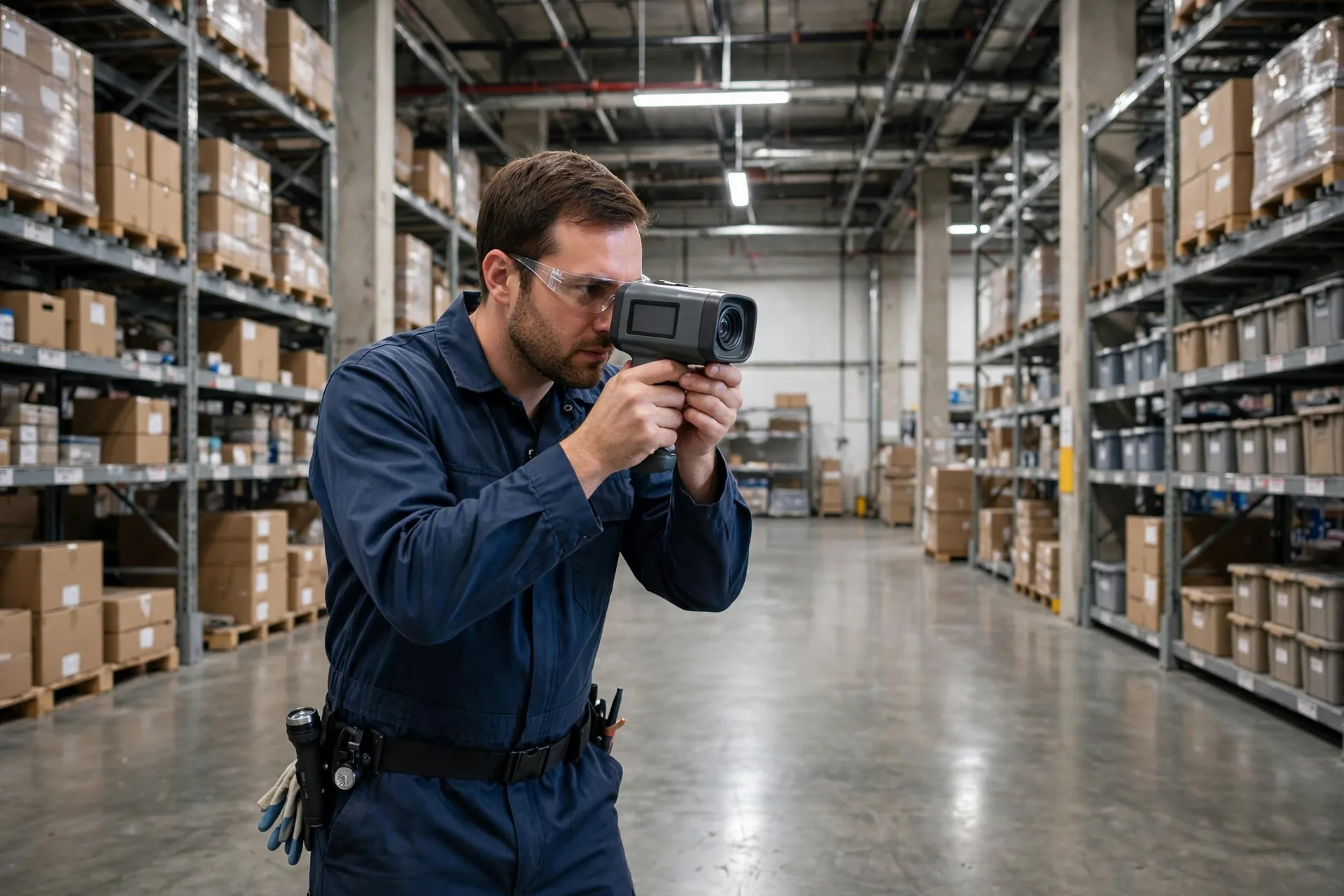
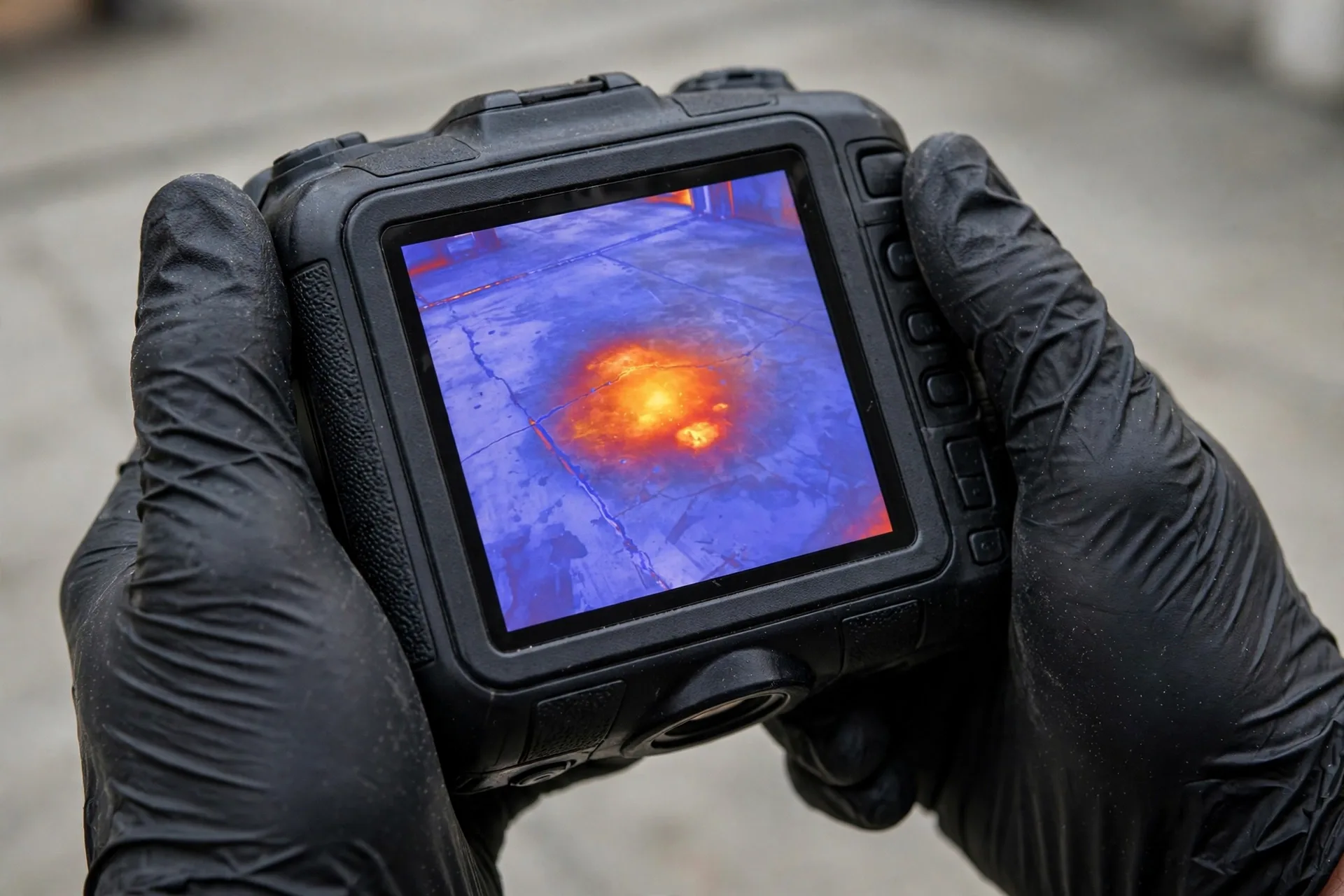
Step 3 — Thermal imaging. An infrared camera scans the slab surface for temperature anomalies. Best done early morning before the building’s HVAC and solar load warm the slab unevenly. On big footprints, the thermal pass is often done in sections and stitched into a floor-plan overlay.
Step 4 — Tracer gas confirmation. For ambiguous cases, the isolated zone is charged with a safe hydrogen-nitrogen mix; the gas escapes at the break and is detected at the surface. This is the confirmation pass — two independent methods agreeing on one location before anyone marks concrete.
Step 5 — Marked location and floor-plan report. The deliverable isn’t just a paint mark on the floor. It’s a marked location plus a written report mapped to your floor plan: leak location, methods used, pipe material and depth observed, photos, and recommended repair approach. That report goes to the owner, the insurer, and every repair bidder — so all quotes price the same known job.
The Business-Continuity Case for Detection-First
Here’s the math that convinces building owners: exploratory demolition on a commercial slab is catastrophically expensive even when it finds the leak quickly — and ruinous when it doesn’t.
Consider the alternative paths for a suspected leak under a working warehouse:
- Guess and demolish: cut concrete in the “likely” area, find nothing, cut again. Each cut is downtime in that zone, dust and noise through the building, inventory moves, and concrete restoration that never quite matches. Two wrong cuts can cost more in disruption than the actual repair.
- Detection-first: a scheduled survey during off-hours or a low-activity window. One marked location. Repair bids priced against a known point. The repair itself — often a targeted tunnel or a re-route — phased to keep operations running.
Detection-first also protects you with the insurer. A documented, methodical commercial slab leak detection survey with photos and a written timeline is exactly the kind of evidence that supports a claim; exploratory jackhammering with no documentation is the opposite.
Repair Options Once the Leak Is Marked
Detection tells you where; the repair decision is how. For commercial slabs, the options scale with the building:
- Tunneling: hand-dug access from outside the foundation to the leak point. No interior demolition, no operational disruption inside — the standard choice when the leak is near the slab edge.
- Targeted break-and-repair: open a small, precise section at the marked point, repair, restore. Viable because detection made the opening small and certain.
- Overhead re-route: abandon the under-slab line and run new pipe through walls or ceiling. Often the smartest long-term answer for aging commercial plumbing — it gets the pipe out from under the concrete permanently, and future leaks become accessible repairs instead of slab events.
Your contractor should price all viable options against the detection report. If a bidder wants to skip straight to demolition without a marked location, get a second bid.
Frequently Asked Questions
How is a commercial slab leak detected without tearing up the floor?
The same non-invasive methods as residential, scaled up: zone-by-zone pressure isolation to find the losing zone, acoustic correlators to triangulate along long pipe runs, thermal imaging scans of the slab surface, and tracer-gas confirmation. Nothing gets cut until two methods agree on the location.
How long does commercial slab leak detection take?
Longer than residential — typically a half day to a full day depending on floor area, number of plumbing zones, and access constraints. Scheduling around operations (early morning, weekends, off-shifts) is standard.
Can detection be done while the business is operating?
Usually yes. Acoustic and thermal surveys are non-invasive — no demolition, no water shutoffs beyond brief isolation tests. The noisiest part is walking the floor with equipment. Most surveys are scheduled during low-activity windows as a courtesy, not a necessity.
What does a commercial slab leak cost to repair?
Repair costs vary enormously with location, access, and method — tunneling, spot repair, and full re-routes are different projects with different price tags. Published US ranges for commercial slab work run from a few thousand for targeted repairs to tens of thousands for re-routes; your quote depends on the detection report’s findings. Never accept a repair quote for an unlocated leak.
Will my insurance cover a commercial slab leak?
It depends on your policy and whether the leak was sudden versus long-term seepage — the distinction adjusters care about most. A professional detection report with methods, photos, moisture mapping, and a timeline is the documentation that supports your claim. Report promptly; delayed notification can reduce or void coverage.
Big Slab, Small Target — Find It First
A commercial slab leak is a precision problem hiding inside a large building. The only expensive way to handle it is imprecisely. Detection-first turns 40,000 square feet of guesswork into one marked point on the floor plan — and that’s what keeps the repair on budget and the business running.
Call Kyle Leak Detection Pros at (512) 729-5265. Commercial slab leak detection for Kyle TX warehouses, retail, and offices — zone isolation, acoustic and thermal survey, floor-plan report, scheduled around your operations. For the residential side of slab leaks, see slab leak detection in Kyle TX and our complete slab leak guide.