
Who Pays for Sewer Line Repair in Kyle TX: You or the City? (2026)
Who Pays for Sewer Line Repair in Kyle TX: You or the City? (2026) You have just been told the sewer line is broken. Before the shock of the repair bill, a simpler question hits first: is this even mine to fix? The sewer line runs from your house, under your yard, out to the…
Who Pays for Sewer Line Repair in Kyle TX: You or the City? (2026)
You have just been told the sewer line is broken. Before the shock of the repair bill, a simpler question hits first: is this even mine to fix? The sewer line runs from your house, under your yard, out to the street — and somewhere along that run, ownership changes hands. Where exactly that happens decides who pays, and guessing wrong can mean paying for a repair that was never yours, or waiting on the city for a repair that was always yours.
This guide answers the who pays sewer line repair question for Kyle TX as honestly as the evidence allows. An important caution up front: Kyle utility policy on the exact lateral boundary is not directly verified, so nothing below is stated as Kyle-specific policy. The general principle is explained, the clues that point one way or the other are laid out, and the steps to get a confirmed answer for your address are spelled out.
If you are facing an active backup or a diagnosed break and need the line located and documented, call (512) 729-5265 for sewer leak detection in Kyle TX. A camera inspection with a locate is the evidence that settles where the problem sits, and that evidence is what any responsibility conversation with the city or an insurer will rest on.
Who Pays Sewer Line Repair: The Lateral vs the Main
The sewer system under your street is really two systems joined together. Your lateral is the pipe from your house to the city main, carrying wastewater from every fixture out through the yard. In general terms, the homeowner typically owns the lateral from the house to the city main, and is typically responsible for its maintenance and repair. That is the general principle used across Texas and in most American cities, stated here as “typically” deliberately: the exact boundary point, and any local variation, must be confirmed with the city for your address. For an example of how a city states this general rule, see the City of San Diego’s explanation of sewer lateral responsibility.
The city main is the larger pipe under the street (or an easement) collecting laterals from many homes. The city typically owns and maintains the main. If the blockage or break is in the main, the repair is typically the city’s responsibility, not yours.
The boundary is where your lateral meets the main, usually at or near the street — but its exact location, at the property line, at the curb, at the tap into the main, or at some other defined point, varies by utility. That variation is exactly why this guide does not state a Kyle-specific boundary as fact. A break ten feet from your house is almost certainly in your lateral. A break in the middle of the street is almost certainly in the main. A break near the sidewalk or curb is the grey area where the confirmed answer matters, and where camera evidence plus a call to the city settle it.
The water-line version of this question is separate, with its own boundary rules around the meter. See who is responsible for water line repair — the sewer lateral question is not answered by the water-line answer, and the two should not be conflated.
The Cleanout: Your Best Boundary Clue
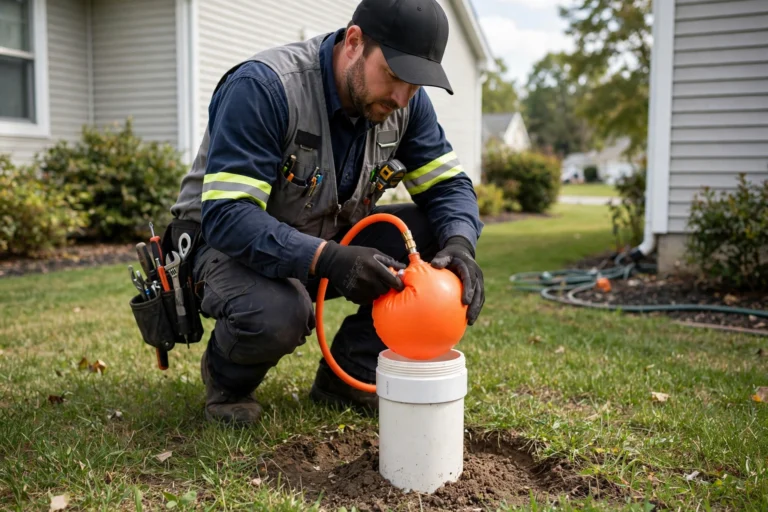
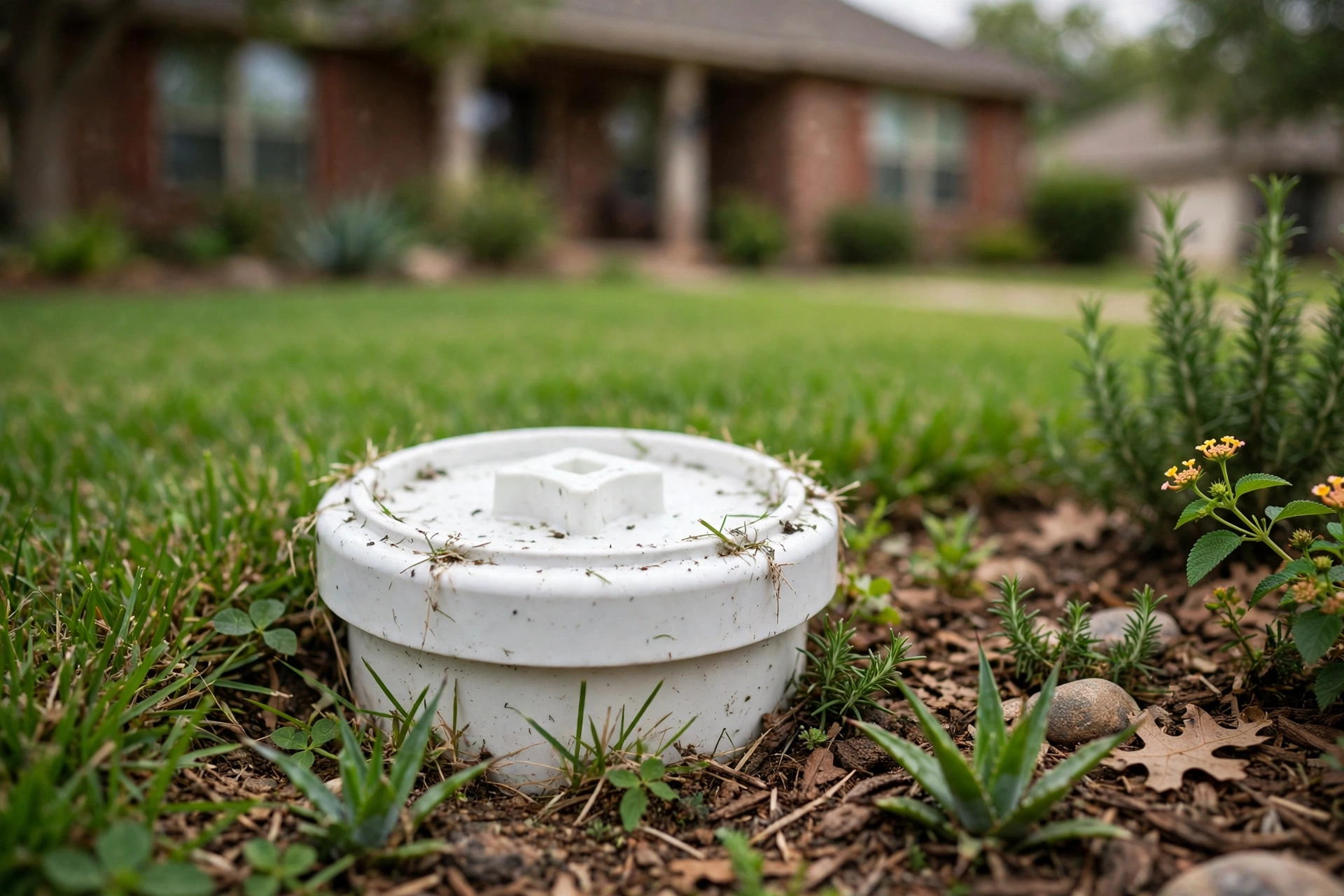
The cleanout — the capped access pipe, usually white PVC, three to four inches across, found in the yard near the house or along the side — is the most useful thing to find. It shows the line’s path to the street, and it gives the camera its entry point, which is how the problem’s location is measured: distance from the house, depth, and position relative to the property line and street.
What the cleanout does not do is decide ownership by itself. A cleanout in your yard does not automatically mean everything beyond it is the city’s, and a cleanout near the street does not automatically mean everything before it is yours. What it gives you is the starting point for evidence. A camera run from the cleanout, with footage and a locate, produces a measured answer. With that measurement, a call to the city becomes a specific question — “the break is at this location, is that on the lateral or the main side of your boundary?” — instead of a general one.
When the Break Is Near the Street, the Sidewalk, or an Easement
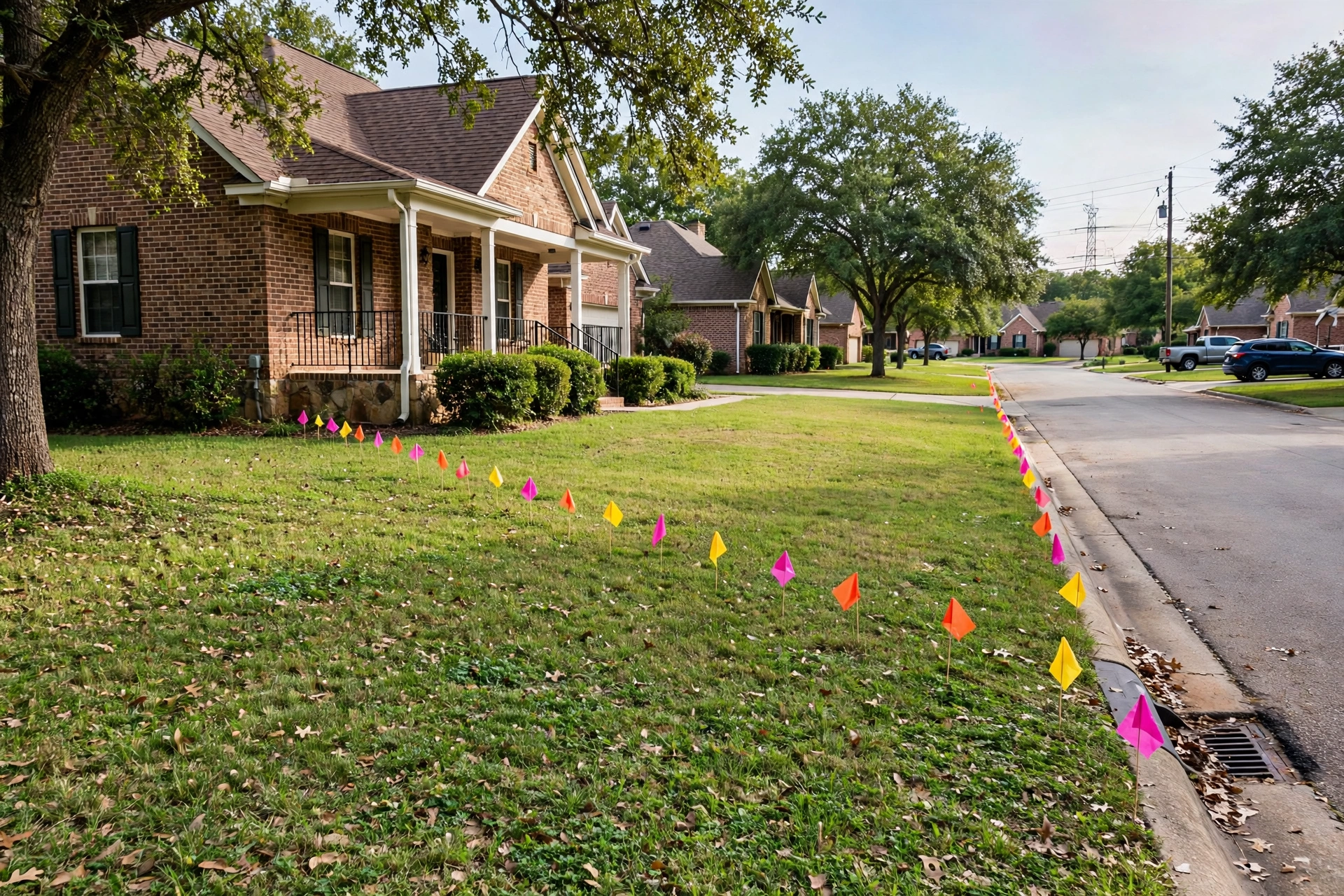
The hardest cases are near the boundary. A break under the front yard is clearly on your side. A break under the street is clearly on the city’s side. The in-between cases — under the sidewalk, under the curb, in the strip between sidewalk and street, or in a utility easement — are where homeowners most often pay for something they should have questioned, or wait for the city to fix something that was theirs all along.
That is why the sequence matters: camera and locate first, then the city call with the measured location, then the decision about who pays. Do not authorize a repair in the grey area on a contractor’s assurance about ownership alone, and do not wait weeks for the city on a break that camera evidence shows is in your lateral. The locate turns a boundary argument into a measurement. That measurement is what settles the who pays sewer line repair question for your address.
Signs the Problem May Be in the City Main
No homeowner can diagnose a city main from inside the house, but a pattern of clues points that way and justifies a prompt call to the city: neighbors affected at the same time, since a single-house problem does not make the whole street back up; sewage surfacing in the street, near a manhole, or between sidewalk and street; backups that worsen when the street main surcharges during heavy rain; or a camera inspection showing a healthy lateral all the way to its connection, with the problem beyond that point. If those clues fit, the who pays sewer line repair answer may be the city, not you.
Documentation, Costs, and Getting the Answer in Writing
Responsibility disputes are won on paperwork, not memory. Gather the camera report and video, with the locate measurements — the single most important document. When you call the city, note the date, the person you spoke to, what they said about the boundary for your measured location, and any work-order number. Keep every quote, invoice, and cleanup receipt together. If you rent, the first call is to your landlord — lateral responsibility sits with the property owner. If you are in a homeowners association, check its documents, since common-area lines can be handled differently. That paper trail is what protects you when the who pays sewer line repair question becomes a dispute.
The boundary also changes the bill. If the break is in your lateral, you pay for the repair, subject to insurance. If it is in the city main, the city typically pays for the main repair, though cleanup inside your home may still fall to you or your insurer. Borrowed Texas-wide ranges, labeled as borrowed and not Kyle quotes, give the scale: minor sewer repair $600–$2,000, partial replacement $2,000–$6,000, full replacement $3,500–$12,000+, trenchless replacement $4,500–$15,000+ (Houston-area guides), with a camera inspection at roughly $125–$500 (Houston) to $260–$1,700 (Angi Austin). The difference between “yours” and “the city’s” on a full replacement can be thousands of dollars — which is why a camera inspection before authorizing a repair is not an extra cost, but the cheapest way to make sure the right party pays for the right repair. Compare your symptom pattern with sewer line leak warning signs as well, so the conversation starts from the symptoms you actually saw.

Frequently Asked Questions
Who pays sewer line repair — the homeowner or the city?
In general terms, the homeowner typically owns and pays for the lateral from the house to the city main, and the city typically owns and pays for the main itself. That is the general principle, not a confirmed Kyle-specific policy — Kyle utility policy on the exact boundary is not directly verified, so confirm the boundary for your address with the city, and use a camera inspection with a locate to establish exactly where the problem sits.
How do I know if the break is in my lateral or the city main?
A camera inspection with a yard locate gives a measured answer: distance from the house, depth, and position relative to the street and property line. Neighbors affected at the same time, or sewage surfacing in the street, point toward the main. Take the measured location to the city and ask for a confirmed answer for that spot.
Does the city pay if the sewer break is under the sidewalk?
Not automatically. Location alone does not decide ownership — a lateral can run under a sidewalk or curb and still be the homeowner’s until it meets the main. Get the camera locate, then confirm with the city whether that measured location is on the lateral or main side of their boundary.
Should I get a camera inspection before calling the city?
Yes, in most cases. The camera report and locate are the evidence the city will need, and they protect you if the problem turns out to be in your lateral. If sewage is actively backing up or surfacing in the street, notify the city promptly as well — the two calls are not either/or.
Will insurance cover my sewer line repair?
It depends on your policy. Standard policies often exclude sewer line wear and underground pipe failure, while a sewer backup or service-line endorsement may cover some or all of it. Check your own policy wording and speak to your insurer with the camera report in hand rather than assuming coverage either way.
Get the Location First, Then the Answer
The who pays sewer line repair question is answered by a measurement, not a guess. Camera-inspect the line, locate the problem, confirm the boundary with the city for your address, and only then authorize the repair — in that order. Get the who pays sewer line repair answer in writing before you authorize any repair.
Call Kyle Leak Detection Pros at (512) 729-5265 for sewer leak detection in Kyle TX — camera inspection, yard locate, and written findings, with your exact price confirmed on the call.