How to Find an Underground Water Line Leak Without Digging Up Your Yard (2026)
There’s a soggy patch in your yard that never dries. Your water bill jumped $80. And the thought running through your head is: “Are they going to tear up my entire lawn to find this thing?” Here’s the good news: that’s not how professionals find an underground water line leak anymore. If you’re wondering how…
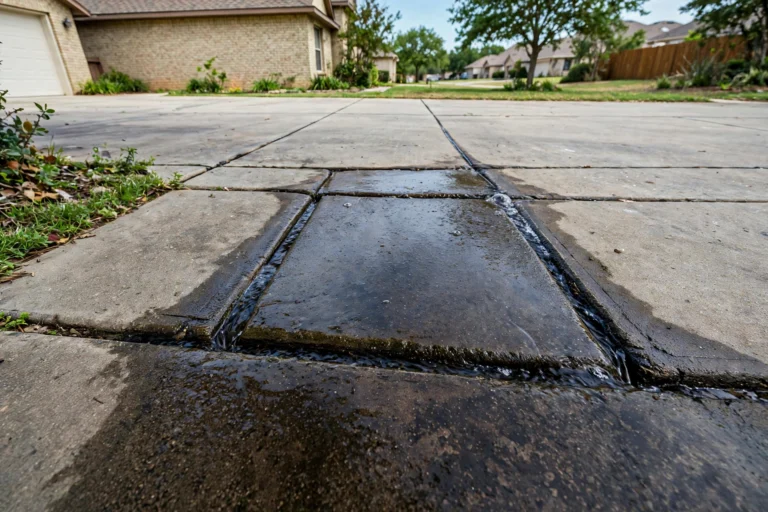
There’s a soggy patch in your yard that never dries. Your water bill jumped $80. And the thought running through your head is: “Are they going to tear up my entire lawn to find this thing?”
Here’s the good news: that’s not how professionals find an underground water line leak anymore. If you’re wondering how to find underground water line leak problems without excavation, modern leak detection pinpoints a yard-line leak to within a foot or two — before a single shovel hits the ground. No exploratory trenches across your landscaping. No “dig and hope.”
This is exactly what a detection visit looks like in Kyle, TX: the five steps, the tools, what it costs, and why Kyle’s clay soil actually changes how the work gets done.
The short version: a $150–$400 detection visit finds the leak with equipment and gives you a marked location plus a written report — so any repair quote you get is for a known problem, not a guess. Call (512) 729-5265.
Step 1: The Meter Isolation Test — Confirming It’s Really a Leak
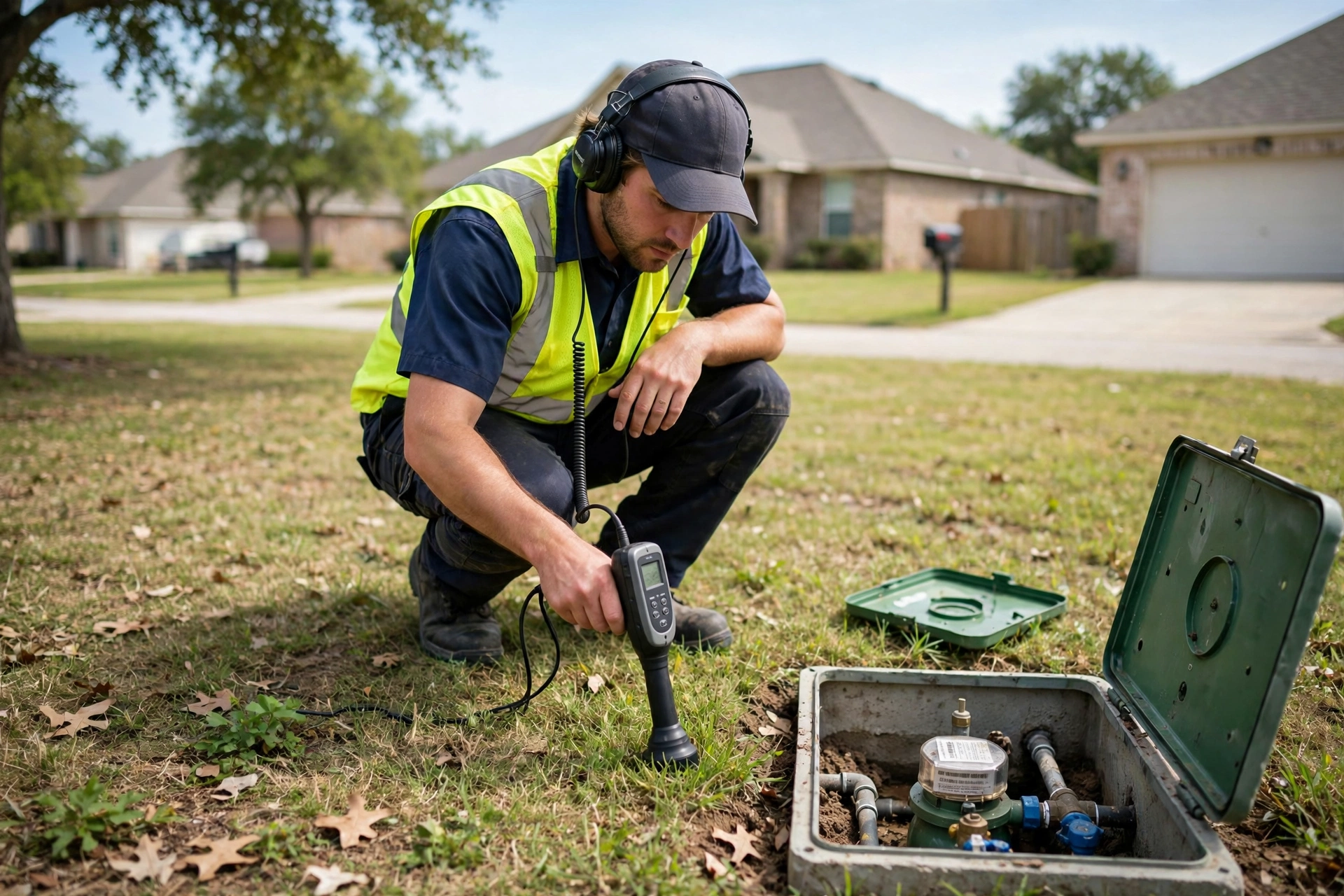
Every visit starts at the water meter, not with a shovel. The technician runs a version of the 15-minute meter test: everything in the house gets turned off — faucets, ice maker, irrigation controller, all of it — and then they watch the meter.
If the meter’s leak indicator spins with everything off, water is leaving your system somewhere it shouldn’t. That’s confirmation. But the meter test does something even more valuable: it tells the technician which side of the meter the leak is on.
- Meter still spins with the house’s main shutoff valve closed → the leak is between the meter and your house (the yard service line). That’s this article’s territory.
- Meter stops when the house valve closes → the leak is inside the house or under the slab — a different problem with different tools.
When homeowners ask how to find underground water line leak trouble, this two-minute test is always step one — it aims the entire investigation. (It’s also the test that settles the “is it mine or the city’s?” question — see our guide on who pays for water line repair.) A spinning meter deserves prompt attention — the EPA WaterSense program notes that household leaks are among the largest sources of residential water waste, which is why catching them with this test matters.
Step 2: Tracing the Line’s Path — Finding Where the Pipe Actually Runs
Here’s something most homeowners don’t realize: nobody knows exactly where your yard water line runs — not you, not the plumber, not the city. Old as-builts are unreliable, and lines get rerouted during landscaping, pool installs, and additions.
So the technician traces it. A signal transmitter clamps onto the pipe (usually at the meter or the house shutoff), sending a traceable frequency down the metal line or a tracer wire. The technician then walks the yard with a receiver, marking the pipe’s exact path with paint or flags.
Why this matters: a leak can only be on the line. This is how to find underground water line leak corridors — knowing the path narrows a whole yard down to a single corridor, often a strip just a few feet wide. Everything after this happens along that marked line.
For plastic (PEX/PVC) lines without tracer wire, technicians use ground-penetrating radar (GPR) or insert a traceable sonde. It takes longer, but the principle is the same: map the pipe before hunting the leak.
Step 3: Acoustic Listening — How to Find Underground Water Line Leak Noise
This is the core of underground leak detection. A pressurized water line forces water out through the break, and that escaping water makes noise — a hiss, a whoosh, a vibration in the pipe and surrounding soil. Acoustic equipment hears what your ears can’t.
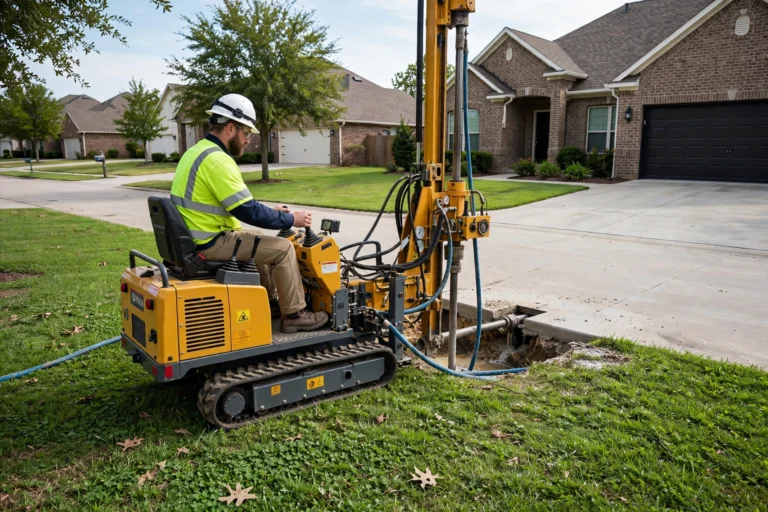
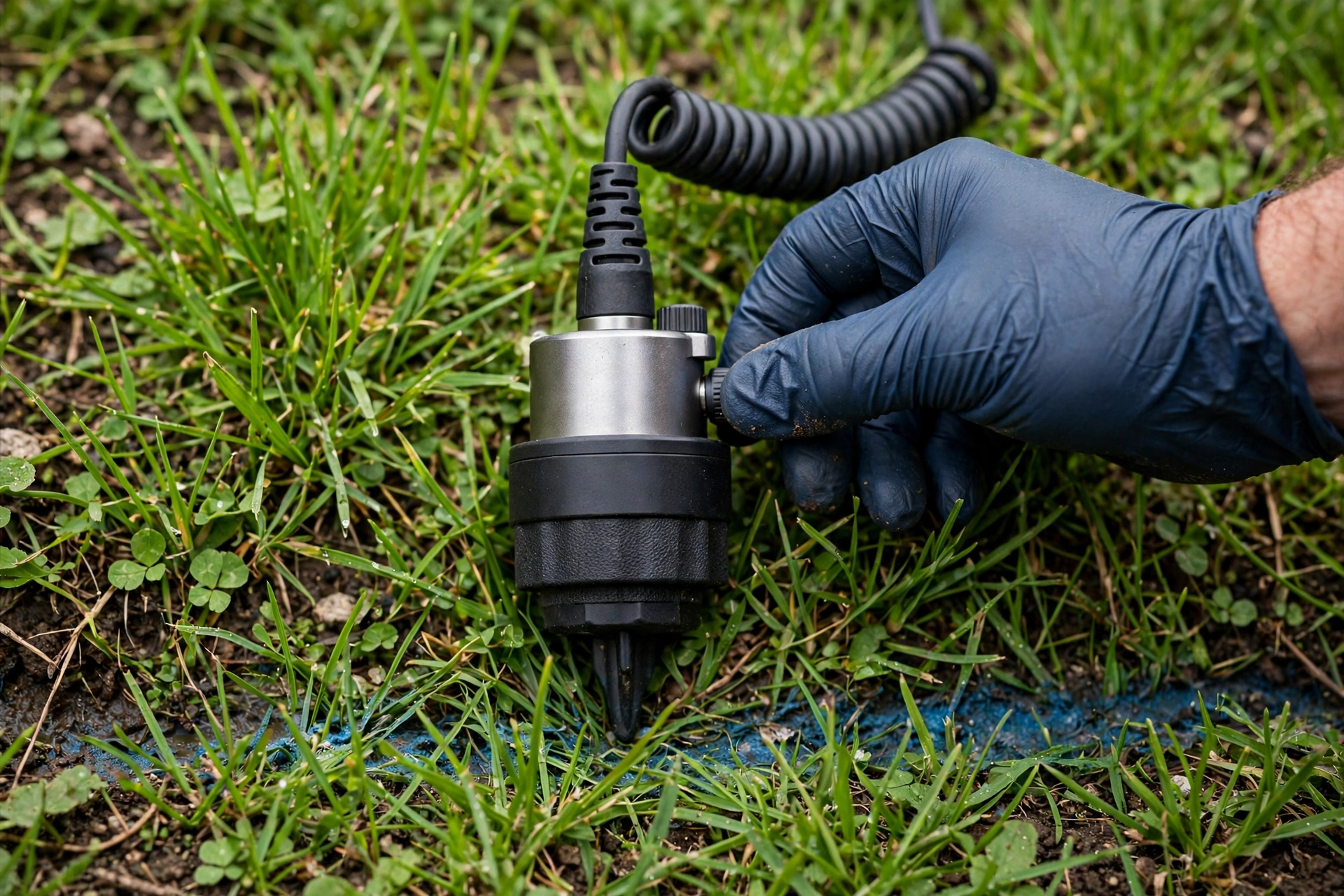
The technician places highly sensitive ground microphones along the marked pipe path, listening at intervals. The sound is loudest directly over the leak and fades as you move away — so by comparing readings at multiple points, they triangulate the break to within a couple of feet.
For longer runs, they use acoustic correlators: two sensors clamped to the pipe at known points (say, the meter and the house valve). The correlator measures the tiny time difference in when the leak noise reaches each sensor and calculates the exact distance to the break. It’s the same principle as figuring out where lightning struck by counting seconds — except measured in milliseconds.
Why Kyle’s Clay Soil Changes the Acoustics
Here’s the Kyle-specific part competitors never mention. Sound travels differently through different soils, and our Blackland Prairie clay is unusual:
- Wet clay conducts leak noise well. A leak that’s been running a while saturates the surrounding clay, and saturated clay transmits the hiss clearly. Ironically, established leaks are often easier to hear.
- Dry, cracked summer clay scatters sound. In August, when the ground is baked and fissured, acoustic readings get noisier. Experienced local technicians compensate by listening at more points and cross-checking with other methods.
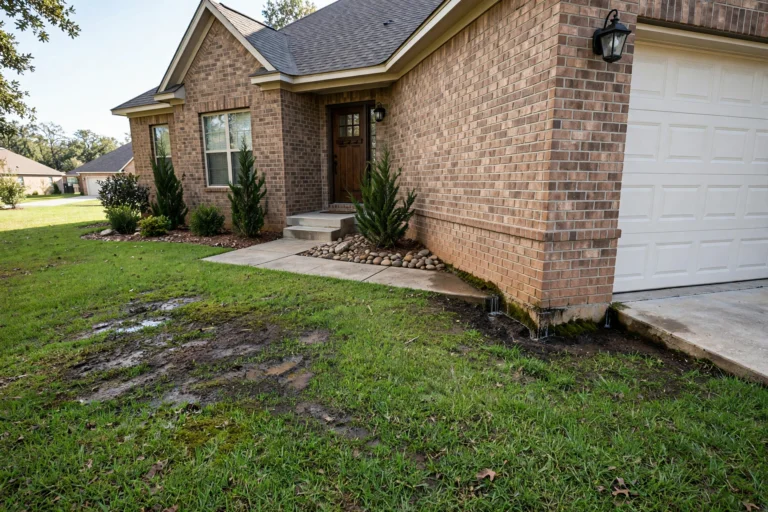
- Clay holds water near the surface. Unlike sandy soil where leak water drains down and away, Kyle’s clay traps it — which is why that soggy patch persists and why the leak’s surface symptoms sit close to the actual break.
A technician who works Kyle regularly knows these quirks. A generic out-of-town crew with one microphone and no local soil sense? That’s how yards get dug up on guesses.
Step 4: Thermal Imaging and Tracer Gas — Confirming Before Anyone Digs
Acoustic listening finds the likely spot. Before anyone commits to digging, good technicians confirm it with a second method:
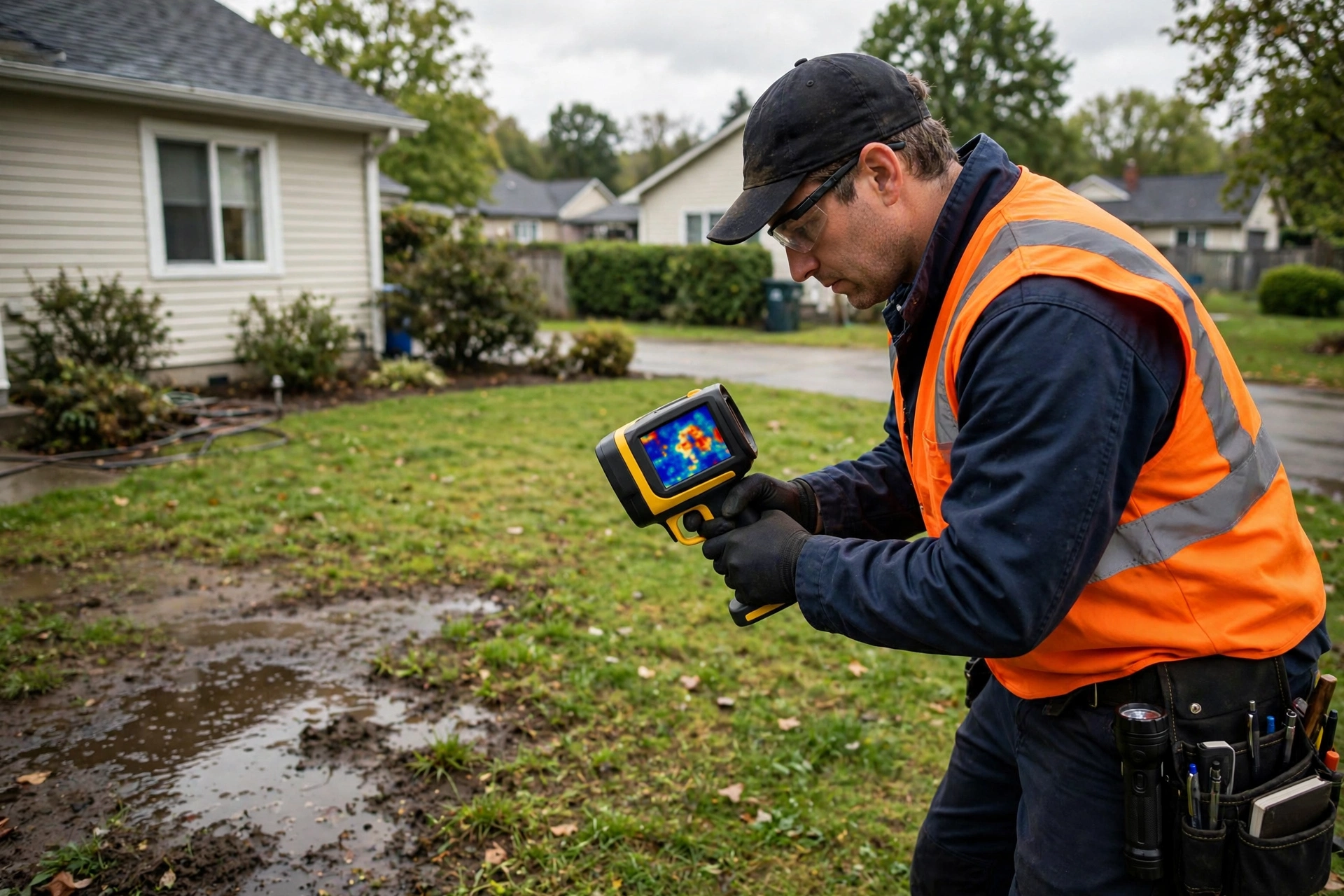
- Thermal imaging: an infrared camera scans the ground along the marked line. Leak water is cooler than sun-warmed soil (or warmer than cold winter soil), so the leak shows as a temperature anomaly on the surface. In Kyle’s clay — which holds that moisture near the surface — thermal confirmation is especially effective.
- Tracer gas: for stubborn cases, the line is drained and filled with a safe hydrogen-nitrogen mix. Hydrogen molecules are tiny and rise straight up through the soil at the break point, where a sensitive gas detector sniffs them out at the surface. It’s the most precise method available and works even when the leak is too small to hear.
Two independent methods agreeing on the same spot is the standard for how to find underground water line leak locations with confidence. One method is a lead; two methods are a location. Any detection company willing to mark your yard on a single reading is cutting corners.
Step 5: The Marked Location and the Written Report
The visit ends with two things:
- A physical mark on your yard — paint or a flag showing exactly where the leak is, so any repair crew digs one hole, not five.
- A written report — leak location, pipe material and depth observed, the methods used, and photos. This report is what makes repair quotes comparable: every bidder prices the same job instead of guessing their own scope.
The whole visit typically takes 1–3 hours. Your yard gets some paint marks and small test points — not trenches.
What a Detection Visit Costs in Kyle TX
| What’s included | Typical Kyle cost |
|---|---|
| Meter isolation test + consultation | Included |
| Line tracing (pipe path mapping) | Included |
| Acoustic leak pinpointing | Included |
| Thermal/tracer-gas confirmation | Included |
| Marked location + written report | Included |
| Total detection visit | $150–$400 |
For anyone comparing how to find underground water line leak services, that’s the full job — not a per-hour meter running while someone wanders your yard. Be wary of anyone who wants to charge hourly for detection or who skips straight to “let’s dig and see.” (Full cost context: leak detection cost in Kyle TX.)
Why “Just Dig and Look” Costs More Than Detection
Some homeowners searching how to find underground water line leak help skip detection to “save” the $150–$400. Here’s the math on that decision:
| Detection first | Dig first | |
|---|---|---|
| Finding the leak | $150–$400, no digging | $0 upfront… |
| Repair excavation | One precise hole | Exploratory trench(es) across the yard |
| Landscape restoration | Minimal — one spot | Re-sodding, replanting, regrading |
| Risk of missing | Near zero (two-method confirmation) | High — leak may be feet from the trench |
| Total real cost | Detection + one repair | Often 2–3× the repair alone |
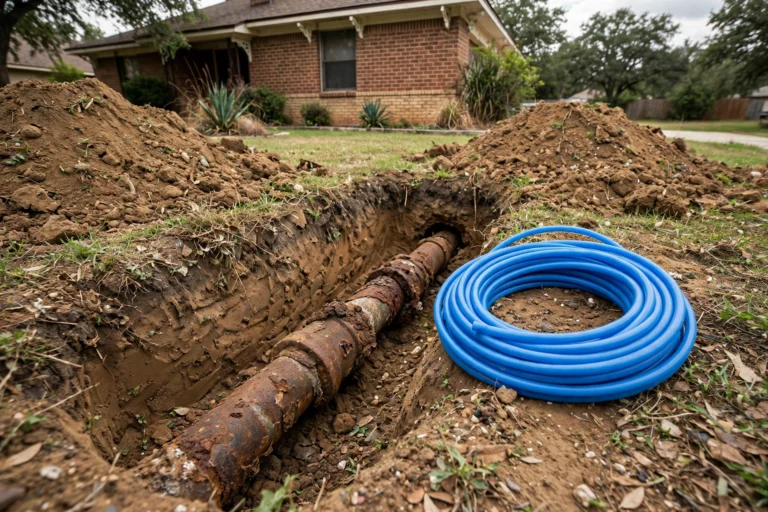
An exploratory trench through a Kyle yard in clay soil isn’t just a hole — it’s compacted, rutted ground that needs real restoration. The “savings” of skipping detection evaporate the first time a backhoe opens the wrong section of lawn. Every reputable repair quote in town assumes the leak location is already known; without it, you’re paying for someone’s guesswork.
How to Prepare for a Detection Visit (5 Minutes)
You don’t need to do much, but these help:
- Clear access to the water meter — move anything stacked on or around the meter box.
- Know where your main shutoff is — the technician will need it. (Don’t know? Read our shutoff valve emergency guide.)
- Note your symptoms — when the bill jumped, where the soggy spot is, any sounds. Timeline helps.
- Keep pets inside — technicians walk the whole yard with equipment.
- Don’t pre-dig anything — seriously. Let the equipment do its job first.
Frequently Asked Questions
How do plumbers find an underground water line leak without digging?
In five steps: meter isolation test to confirm the leak, electronic line tracing to map the pipe’s path, acoustic listening (ground microphones/correlators) to triangulate the break, thermal or tracer-gas confirmation, then a marked location with a written report. No exploratory digging. That’s how to find underground water line leak breaks without tearing up the yard.
How accurate is acoustic leak detection?
With two-method confirmation (acoustic + thermal or tracer gas), the marked location is typically within 1–2 feet of the actual break. That’s precise enough for a single repair excavation.
Can a leak be found under concrete or a driveway?
Yes — acoustic and tracer-gas methods work through concrete. The line gets traced, the leak gets pinpointed, and then the repair method (boring, tunneling, or a single cut) is chosen based on the exact location.
How long does a detection visit take?
Usually 1–3 hours for a residential yard service line in Kyle, depending on line length, pipe material, and soil conditions.
Will detection damage my yard?
No. The visit leaves paint marks or small flags and possibly minor test points. There is no trench digging during detection — that’s the entire point.
Find It First, Dig Once
The most expensive yard leak repair is the one that starts with a backhoe and a guess. If you need to know how to find underground water line leak issues in Kyle, detection-first is cheaper, faster, and the only approach that gives you comparable repair quotes.
Call Kyle Leak Detection Pros at (512) 729-5265. $150–$400, 1–3 hours, marked location, written report — and your yard stays intact until the repair crew knows exactly where to dig. Start with water line leak detection in Kyle TX.